
REVIEW · FRANCE GHOST TOURS
Medieval Carcassonne: Interactive Ghost Story & City Game
Carcassonne’s famous citadel is easy to admire and surprisingly easy to rush through. This phone-based ghost story slows you down, sending you from Square Gambetta across the Aude and up toward Château Comtal while small details in the streets provide the answers. I like the route’s mix of the lower town, riverfront, and fortified Cité. I also like that you can stop for lunch, save your progress, and continue later.
The catch is the app setup. A few players had trouble getting started or receiving access, and the instructions were not always clear. Give yourself time to sort out the Questo app before you set off, and contact support quickly if something fails.
Six useful things to know before you start
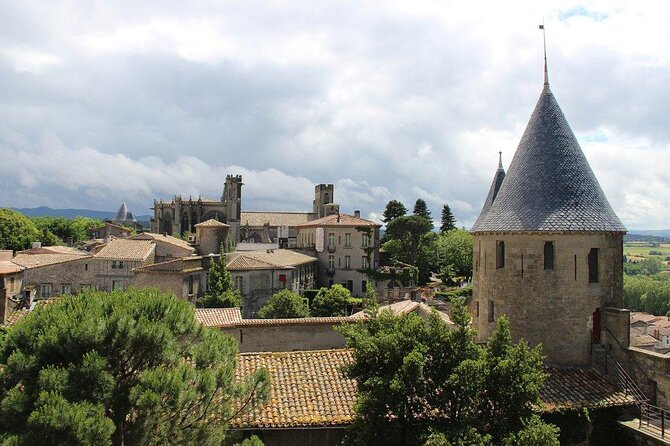
- The route begins outside the Cité: Meet at Square Gambetta in La Bastide de Saint Louis, then cross toward the medieval fortifications.
- Ten puzzles cover roughly 3 kilometres: You look closely at buildings, gates, signs, and architectural details to move forward.
- The finish is Château Comtal: The game guides you step by step, but entry to the castle and other monuments costs extra.
- You control the clock: Start any time during the stated operating hours, pause whenever you wish, and resume later.
- One phone can be enough: The game is charged per person, but a group can play together on one device if that suits you.
- English is the only stated game language: Translation tools may help if you are more comfortable in French, Spanish, German, or another language.
A city game with a darker side
This is not a standard walking tour with a guide waiting at a meeting point. It is a private, self-guided route delivered through the Questo app. You follow prompts, inspect your surroundings, and enter answers to continue.
The ghost-story theme gives the walk a little tension, but the main subject is Carcassonne itself: its medieval defenses, religious buildings, periods of disease, religious persecution, trade, and later restoration. The tone is intended to suit families, though some subjects are serious and the puzzle format may not hold every child’s attention.
I would think of the experience as a sightseeing walk with game mechanics, not as an escape room transplanted outdoors. The puzzles make you look up at stonework and notice corners you might otherwise pass. The story gives those places a reason to matter.
The route takes about 1 hour and 40 minutes and covers approximately 3 kilometres. That timing is only a guide. You may move faster if you know the city, or take much longer if you stop for photographs, food, church visits, or castle tickets.
A few more ghost walks around France worth a look
- Paris: Haunted Père Lachaise Cemetery Guided Tour
★ 4.6 · 3,591 reviews - Paris: Dark History and Ghostly Guided Walking Tour
★ 4.7 · 1,000 reviews - Paris by Night Walking Tour: Ghosts, Mysteries and Legends
★ 4.5 · 924 reviews
Starting at Square Gambetta and La Bastide
Square Gambetta is on the opposite side of the Aude from the famous walled Cité. It marks the beginning of La Bastide de Saint Louis, the lower town built under King Louis IX.
This is a sensible starting point because it gives you a useful contrast. Carcassonne is not just the postcard fortress on the hill. It is also a living town with broad streets, later buildings, commercial links, and a long relationship with the river.
Your first challenge asks you to inspect the square and find a detail that points you onward. That opening sets the pattern for the whole activity. You are not simply told a fact and sent along. You must pay attention to the setting before the next part of the story appears.
If you are playing with children, explain this rule at the start: do not hurry to the next location. The answer is usually found by looking carefully at what is around you. A small group can share one phone and solve each puzzle together, which may be easier than trying to manage several devices.
Notre Dame de la Santé beside the old bridge
The next stop is the little chapel of Notre Dame de la Santé, near the Pont-Vieux. The chapel was built in 1527 with money from the legacy of Jean de Saix and served as a hospital for people suffering from the plague.
Its location matters. The narrow passage between fortified buildings was a strategic point, and the chapel was regarded as a protective presence there. This gives the game a strong setting for its darker themes: illness, fear, faith, and the hazards of life in an old walled city.
You may find this stop more rewarding if you take a moment to look at the relationship between the chapel, the bridge, and the fortifications. The game asks you to find an answer in the surroundings rather than treating the building as a quick photo stop.
One caution: if you expect a long explanation of plague medicine, you may find the treatment brief. The supplied details place disease within the wider story, but this is not a specialist medical history tour. Its aim is to keep you moving and solving.
The old cloth factory and Carcassonne’s working past
At the foot of the Pont-Vieux, on the right bank of the Aude, you reach a facade tied to Carcassonne’s prosperous cloth industry.
The building once belonged to a noble Carcassonne family. In 1694, it was bought by a person connected with Colbert, the powerful French minister, and turned into a cloth factory. It received the title Manufacture Royale in 1696.
The surviving owners’ residence is important because it is the only visible building from this period noted along the route. Its design resembles buildings in the Lower Town from the eighteenth century. This is a useful reminder that Carcassonne’s story did not stop in the Middle Ages. Wealth, manufacturing, and royal-backed industry shaped the city long after its walls and towers were built.
I like this part of the route because it broadens the picture. The old city is not only about knights, Cathars, and castle walls. It was also a place of work, trade, and money. The game’s format works well here because you must examine a facade that could otherwise blend into the riverfront.
More city tours in France:
- A City of Shadows: Dark Tales of Paris by Night
★ 5.0 · 5 reviews - Savannah’s Ghost City “Dead of Night” Walking Night Tour
★ 4.5 · 2,482 reviews - Creepy Krakow: 2-Hour City Walking Tour
★ 4.7 · 1,131 reviews - Gangsters and Ghosts Tour New York City
★ 5.0 · 905 reviews
Saint-Gimer Church and Viollet-le-Duc’s modest design
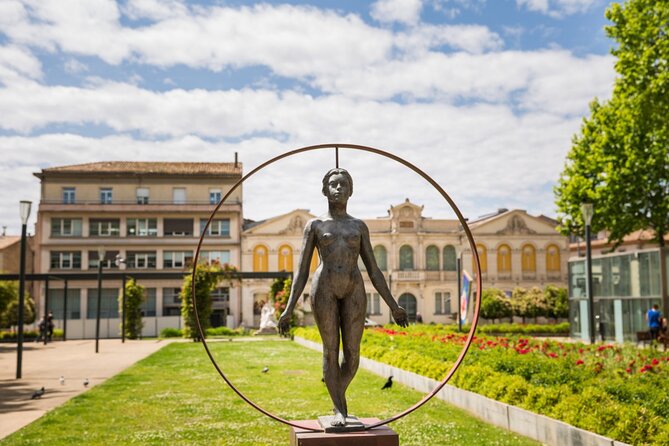
Saint-Gimer Church was built between 1854 and 1859 by Eugène Viollet-le-Duc, the architect best known for his major restoration work in Carcassonne.
The church was designed with modesty in mind. It has a nave, two aisles, a polygonal apse, two vestries, and a porch at the front. The compact plan is worth noting because it differs from the grand scale many people expect from a nineteenth-century church associated with such a famous architect.
This stop adds another layer to the city. You move from medieval buildings to a later work shaped by a man deeply involved in Carcassonne’s restoration. It also helps you see that the city’s appearance comes from several eras, not from one untouched medieval moment.
The puzzle will ask you to inspect the church and use a visible detail. If you are interested in architecture, this may be one of the more satisfying stops. If your priority is an audio explanation inside every building, keep expectations in check. This is a visual game, not a recorded audio guide.
Porte de l’Aude and the climb toward the Cité
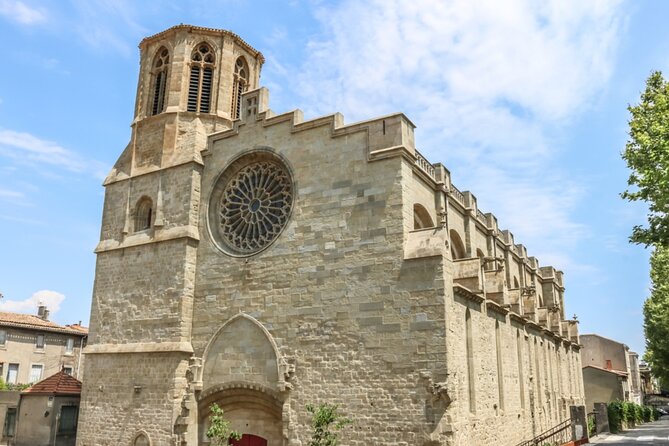
Porte de l’Aude is one of the preserved entrances to the medieval walled city. It overlooks the Aude and gives you a strong sense of how the fortifications used the river and steep ground as part of their defense.
The approach is more atmospheric than simply entering through the most familiar tourist gateway. You see the walls from the river side and begin to understand how the Cité was protected. The gate is also a good place to pause and orient yourself before the route takes you farther into the fortified area.
The game depends on observation, so look at the gate’s shape, masonry, openings, and surrounding walls. You may need to share the work if your group includes children. One person can read the prompt while another searches for the detail.
This section can feel less smooth if you are concentrating only on the phone. Put the screen away between instructions and use it as a prompt, not as your entire view of Carcassonne. The point of the activity is to notice the real place.
The Inquisition Museum and difficult subjects
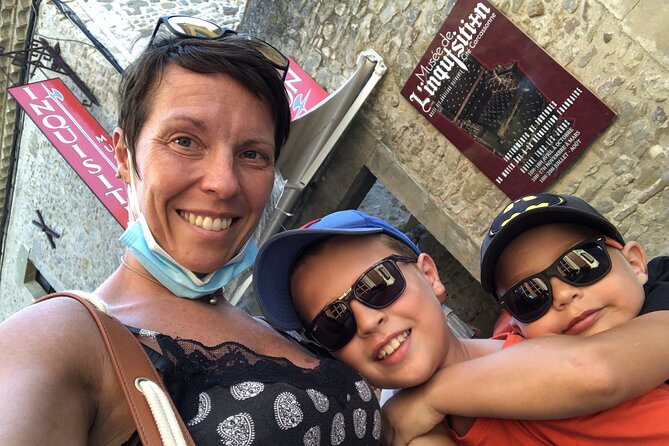
The Inquisition Museum occupies a large seventeenth-century building and presents instruments of torture dating from the twelfth century through the French Revolution. It also covers important figures, their biographies, the Inquisition, and the Cathar castles connected with the region.
The museum is listed as one of the stops, but admission is not included in the game. You can pass the location as part of the route without buying a ticket, or pay separately if you want to visit.
This is the stop most likely to affect your choice of activity. The subject matter is grim, and families should decide in advance if it suits their children. The ghost-story framework may make the material feel dramatic, but it does not turn the Inquisition into light entertainment.
The route gives you a brief historical link rather than a full museum visit. If you want detailed information about instruments, people, and Cathar strongholds, allow extra time and budget for the museum itself. If you want a short outdoor game with a darker historical thread, the stop gives the story more weight.
The cathedral, Roman walls, and Château Comtal
The final section brings you to the religious and military heart of the Cité. The present Romanesque cathedral began in June 1096. A Lady Chapel was added in the early fifteenth century, beside an infirmary and a chapel built by Bishop Radulph in the 1260s.
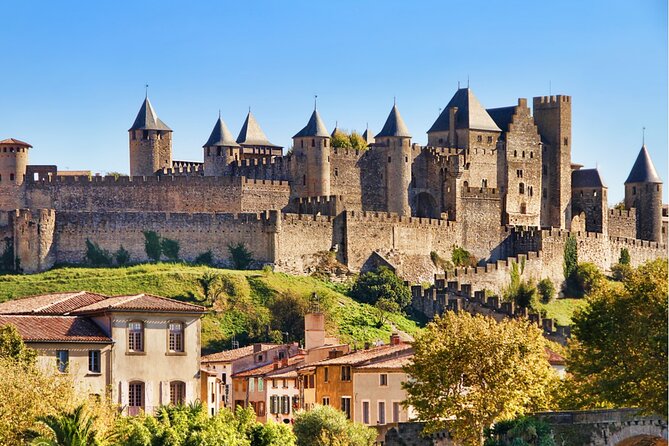
Nearby, Château Comtal was built in the twelfth century by Bernard Aton Trencavel over the western part of the Roman walls. The castle is the endpoint of the game, and the app guides you there step by step.
Finishing at Château Comtal gives the route a clear payoff. You have crossed from the lower town, passed the river, followed the old defenses, and reached the castle complex. The game itself does not include entry tickets, so you need to pay separately if you want to go inside.
I suggest treating the finish as the beginning of a second visit. Once the puzzle is complete, you can explore the castle at your own pace if you have time. The activity gives you a framework for seeing the Cité, but it does not replace a full castle visit or a guided explanation of every wall and room.
What the $6 price really buys you
At $6 per person, this is inexpensive for a private activity covering about 3 kilometres and ten interactive puzzles. The value comes from the structure. You get a planned route, local stories, and a reason to examine parts of Carcassonne that you might otherwise pass.
The price is less attractive if every person expects to use a separate phone. One player noted that a single device was enough, despite paying for four people. For a family or small group, decide before booking how you want to play. A shared phone can reduce hassle, but separate devices may help if people want to solve independently.
The low price also does not cover monument admission. Add the cost of Château Comtal or the Inquisition Museum if you plan to enter. This keeps the basic walk affordable, but you should not mistake the $6 fee for an all-inclusive sightseeing ticket.
Group discounts are available, and groups larger than 15 are asked to make multiple bookings. Since the activity is private and contactless, you are not combined with strangers or assigned a physical guide.
App setup, timing, and practical advice
Confirmation arrives at booking, and the game is accessed through the Questo app. The stated operating hours are 6:00 in the morning to 11:30 at night, from Monday through Sunday, with the published schedule running through July 2, 2027.
The flexible timing is one of the best features. You can start when you want, stop for a meal, and continue later. One player even resumed the route more than 24 hours after starting because of a low phone battery. That is useful in Carcassonne, where heat, crowds, meals, and castle visits can easily change your plan.
The main practical weakness is starting the game. Some players found the access steps confusing, had difficulty getting the quest to open, or lost time trying to make the app work. Before walking to Square Gambetta, install the required app, check the booking email, and make sure your phone has enough battery and mobile access.
If the game will not start, use the provider’s in-app chat or contact [email protected]. Support is stated to be available 24 hours a day, seven days a week. Do this early rather than spending an hour trying the same steps repeatedly.
The route is near public transportation, and service animals are allowed. Most people can take part, but remember that this is a walking activity through an old city. Comfortable shoes and a charged phone make more difference here than fancy equipment.
Who should choose this Carcassonne experience?
I would recommend it to you if you like self-guided sightseeing, small puzzles, local legends, and the freedom to set your own pace. It suits couples, families with older children, and friends who prefer not to join a fixed group.
It is especially useful if you have already seen the main postcard views and want a reason to explore the transition between La Bastide, the river, and the Cité. The route gives you a simple plan for a first afternoon in town.
I would hesitate if you want a human guide, a detailed audio commentary, or a carefully explained account of Cathar history and medieval persecution. The game is in English, and other language options are not stated. Players who do not follow English comfortably may need a translation tool.
Children can enjoy the hunt for answers, but the format requires them to stop, look, read, and wait while the group enters responses. Younger children who are more interested in running around than solving clues may make the game harder to manage.
Should you book it?
Book it if you want a low-cost, flexible way to connect Carcassonne’s lower town with its famous fortress. The strongest parts are the independent pace, the route’s range of sights, and the way the puzzles draw your eyes to details in gates, churches, facades, and walls.
Skip it if app problems would ruin your day or if you need a guide to explain every stop in depth. To get the best value, use one well-charged phone, install the app before arriving, allow extra time for monument visits, and treat the puzzles as a prompt to look around rather than a substitute for seeing the city.
FAQ
Where does the Carcassonne city game start?
It starts at Square Gambetta, 11000 Carcassonne, on the side of the Aude opposite the famous Cité.
Where does the activity finish?
The route ends at Château Comtal. The Questo app provides step-by-step directions to the finish.
How long is the activity?
The estimated duration is about 1 hour and 40 minutes. The route covers approximately 3 kilometres and includes 10 interactive puzzles.
Is a physical guide included?
No. This is a private, self-guided activity played through the Questo app. There is no physical tour guide.
Are entry tickets to the castle or museums included?
No. Entry tickets to Château Comtal, the Inquisition Museum, and other attractions are not included in the activity price.
Can I pause the game and continue later?
Yes. You can start at any hour within the stated opening period, pause whenever you wish, and resume later. The activity offers unlimited access after booking.
Just added around France
- Paris Ghosts and Dark Stories Tour★ 4.0 · 10 reviews
- Père Lachaise’s Cemetery Celebrities and Ghosts Mystery Tour★ 4.5 · 31 reviews
- Haunted Walking Tour of Père Lachaise Cemetery★ 3.0 · 2 reviews
- Paris Mysterious and Dark Stories Walking Tour – Small Group★ 5.0 · 10 reviews
- Ghost & Haunted Walking Tour in Eiffel Tower Exterior at Night★ 3.5 · 3 reviews
- A City of Shadows: Dark Tales of Paris by Night★ 5.0 · 5 reviews
- Nice Old Town: Artists & Ghosts Self-Guided Walking Adventure★ 4.5 · 15 reviews
- Lyon Ghost Hunt: Follow the Shadows Exploration Game★ 4.5 · 26 reviews
France Ghost Tours, compared.

Paris by Night Walking Tour: Ghosts, Mysteries and Legends
Read our review →
Ghosts, Legends & Mysteries Evening Walking Tour
Read our review →
Père Lachaise’s Cemetery Celebrities and Ghosts Mystery Tour
Read our review →
Lyon Ghost Hunt: Follow the Shadows Exploration Game
Read our review →
Browse the lists this tour appears in