
REVIEW · CANADA GHOST TOURS
Ghost Tour of Queen’s University
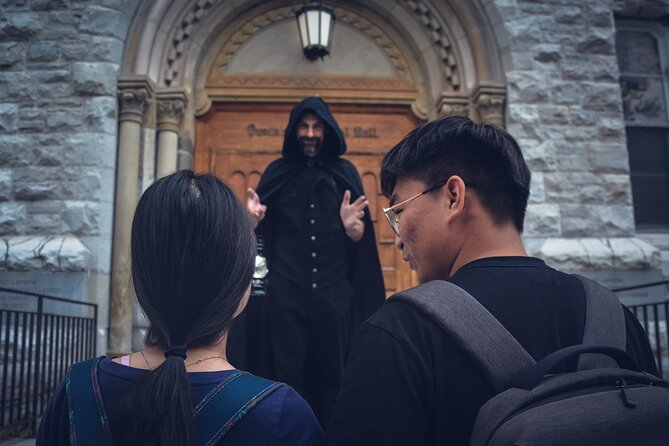
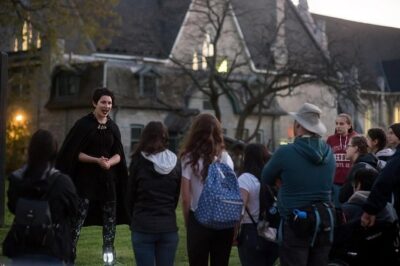
Kingston’s Queen’s University campus is a fine place for ghost stories because the old buildings have genuinely unusual pasts. On this evening tour, you’ll hear about medical-school practices at Summerhill, a tragic poet at Four Directions, and the spirit of Alfie Pierce at the John Deutsch University Centre.
I like the small maximum of 20 people, which should make it easier to hear the guide, and I like the range of settings: churches, art museums, lecture halls, hospitals, and old university buildings. The 8:00 pm start also gives the tour the right mood without pushing too far into the night.
The main consideration is that this is a short, story-led outing, not a theatrical haunted house. At about 75 minutes, the value depends on how much you enjoy local history, campus lore, and a good chill more than special effects or dramatic staging.
Key points about the Queen’s ghost walk
- Historic starting point: Meet at the limestone Kingston Courthouse, a National Historic Site built in the late 1850s.
- Ten story-rich stops: The route includes Queen’s buildings, Chalmers United Church, hospitals, and the Agnes Etherington Art Centre.
- Strong medical-history angle: Summerhill and Kingston’s hospitals bring unsettling stories linked to medical training and old hospital use.
- Notable campus ghosts: Fleming Hall is tied to a story involving Douglas Mill Jemmett, while the John Deutsch University Centre is linked to Alfie Pierce.
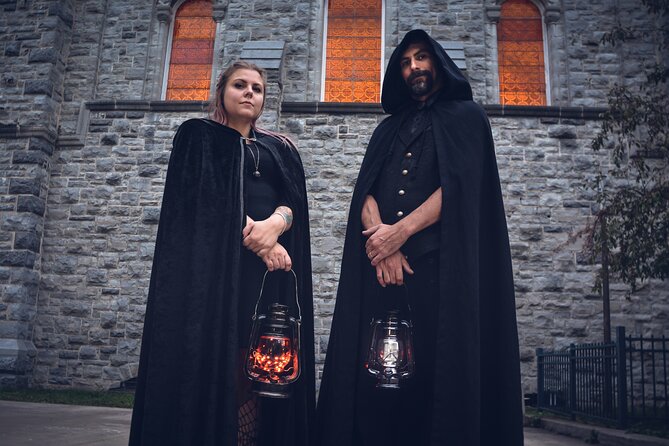
- Small group size: The tour accepts no more than 20 people, a useful limit for an evening storytelling walk.
- Straightforward price and terms: The cost is $25.31 per person, with free cancellation up to 24 hours before the start time.
Begin at Kingston’s limestone courthouse
Your evening begins at 8:00 pm outside the Kingston, Frontenac County Courthouse at 5 Court Street. The building itself sets the tone. Built in the late 1850s in Greek Revival style, it is an imposing limestone structure and a National Historic Site of Canada.
This is more than a convenient meeting point. The courthouse provides the first story, so the tour starts with a building that already carries a sense of age and civic importance. I like that approach. Instead of rushing straight to Queen’s University, the guide begins with one of Kingston’s major historic landmarks.
The starting point is also practical. The courthouse is near public transportation, and the tour ends back at the same location. That makes the evening easier to manage than a route that leaves you across town at the end.
You receive a mobile ticket, and the tour is offered in English. Since the start time is fixed at 8:00 pm, arrive with enough time to find the courthouse and get settled. The group can include up to 20 people, so you are unlikely to be part of a huge crowd, but arriving early can still help you hear the opening story clearly.
A few more ghost walks around Canada worth a look
- Ghostly Walking Tour in Victoria
★ 5.0 · 816 reviews - Old Montreal: Traditional Ghost Walk of the Haunted City
★ 4.7 · 746 reviews - Old Montreal Ghost Walking Tour
★ 4.5 · 726 reviews
Chalmers United Church adds a Gothic chapter
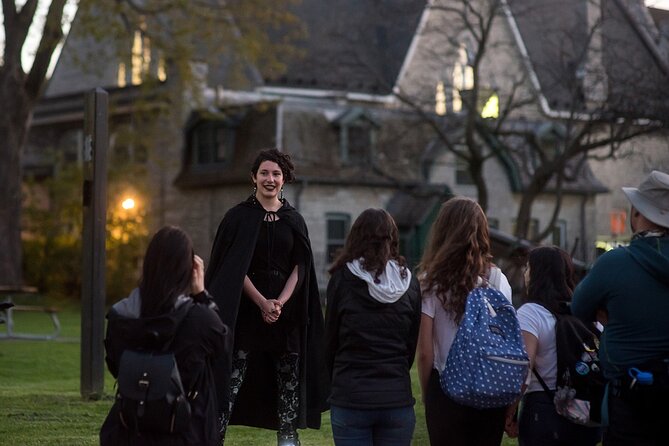
From the courthouse, the tour takes in Chalmers United Church, a heritage building dating from 1890. Its Gothic Revival design gives it the sort of appearance people expect from a ghost-story setting: pointed forms, historic stonework, and a long connection to Kingston’s religious life.
The appeal here is not simply the architecture. The guide shares a specific ghost story connected to the church, giving you a reason to look at the building as more than a handsome old structure. The story adds a layer of unease to a place you might otherwise pass without much thought.
You should keep your expectations sensible. The information provided describes a story about the landmark, not a staged encounter or guaranteed supernatural event. The pleasure comes from hearing the account in front of the building and deciding for yourself how much you believe.
Queen’s University supplies the main setting
Most of the tour’s stories take place around Queen’s University. The campus dates back to the 1840s and combines old stone buildings, green spaces, academic buildings, and newer facilities.
That setting gives the tour variety. A university campus is not a single historic site frozen in time. It is a working place used by students and faculty, which makes the ghost stories feel connected to daily life rather than separated from it. Old buildings remain part of an active institution, and the guide uses that contrast to explain the stories.
The campus also provides the broadest part of the route. You will hear several accounts rather than one long tale, with stops connected to different periods and people. Some stories are tragic, some are unsettling, and some depend on the strange behavior said to occur in a particular building.
I would treat the campus portion as a local history tour with supernatural subject matter. The buildings matter as much as the ghosts. If you enjoy learning why a place looks and functions as it does, you will get more from this than someone seeking only scares.
Fleming Hall and the story of Douglas Mill Jemmett
Fleming Hall is named for Sir Sandford Fleming, a former chancellor of Queen’s. Its wings also honor figures connected with electrical engineering, a department that occupied the building until 1989.
The most chilling story here concerns Douglas Mill Jemmett. The details of the story are part of the guide’s presentation, but the building’s layered naming gives the tale useful context. Fleming Hall is not just an anonymous university block. Its rooms and wings connect to people who shaped Queen’s, and that makes the story feel tied to the institution.
This stop should appeal to you if you like ghost stories with a clear connection to a person and place. It also shows how the tour moves beyond the best-known old buildings. A university hall associated with engineering may not sound spooky at first, but local lore can change how you see it.
Same streets after dark, a different sort of fright:
- Ottawa: Haunted Night Walking Tour
★ 4.5 · 341 reviews - Original Haunted Walk of Ottawa
★ 4.5 · 284 reviews - Toronto: Dark History Nighttime Walking Tour
★ 4.7 · 273 reviews - Ghost Tour of Toronto Original Haunted Walk
★ 4.5 · 185 reviews
Four Directions and the tragic story of Charles Sangster
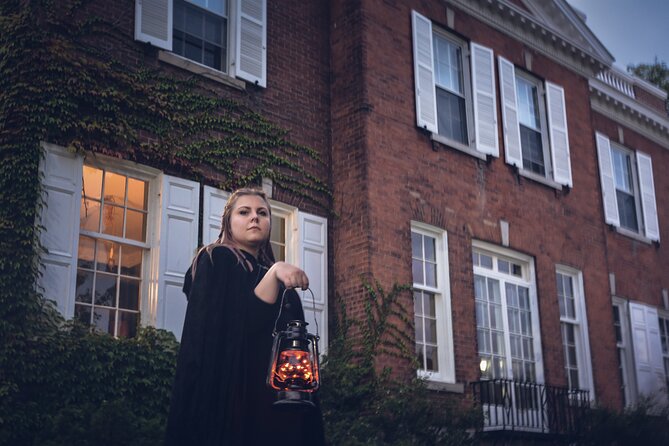
Four Directions was founded in 1996 to support the success of Indigenous students and moved into its current home in 2000. The house itself was built in 1886 and has had several notable residents, including Canadian poet Charles Sangster.
The tour shares Sangster’s tragic story here. That gives the stop a different tone from a simple haunted-building tale. You are hearing about a real historical figure connected with the house, then learning how his life became part of the building’s ghostly reputation.
I appreciate that the stop links the building’s present use with its earlier residents. Four Directions is an active support centre, not merely an old house preserved for display. The setting reminds you that Kingston’s buildings change purpose over time, while stories attached to them can linger.
Summerhill’s medical past is the darkest stop
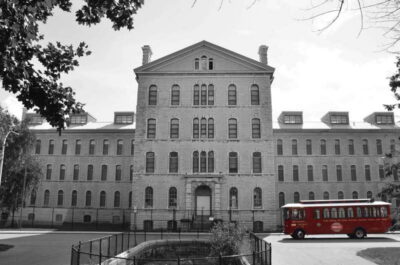
Summerhill may be the most unusual building on the route. Constructed in 1839, it was first planned as the country villa of Archdeacon George O’Kill Stuart. When Kingston served for a time as Canada’s capital, the building became a boarding house for members of the Legislative Assembly.
Queen’s purchased Summerhill in 1854, and for years it was the university’s only building. Later, the medical school used it for practices that the tour describes as very macabre.
That shift in use gives the stop its strongest hook. Summerhill moved from private residence to political lodging to university centre and medical-school site. Each period adds another layer to the building’s story, and the medical connection supplies some of the tour’s most unsettling material.
You should know that the appeal here comes from the account of what happened at the building, not from a promise of seeing anything supernatural. If medical history makes you uncomfortable, this may be the point where the tour feels most disturbing.
Kingston’s hospitals bring a wider city connection
The tour then connects Queen’s medical training with two Kingston hospitals. Kingston General Hospital was built in 1835, but its first building stood empty for three years because the budget ran out before furnishings could be purchased.
That detail alone says something about the city’s early development. The hospital also had several later uses, including service as Canada’s first temporary parliament building. The guide shares ghost stories from two Kingston hospitals, giving the tour a wider reach beyond the university grounds.
This section works well because it shows how Queen’s is tied to Kingston as a whole. Students training in medicine use local hospitals, and those hospitals carry their own difficult pasts. The result is a connected story about education, illness, politics, and death rather than a string of unrelated spooky stops.
The information does not promise interior access to hospital buildings, so expect stories connected with the sites rather than a hospital exploration. That keeps the tour practical and respectful, particularly around places that remain important medical facilities.
The Agnes Etherington Art Centre has an unexpected side
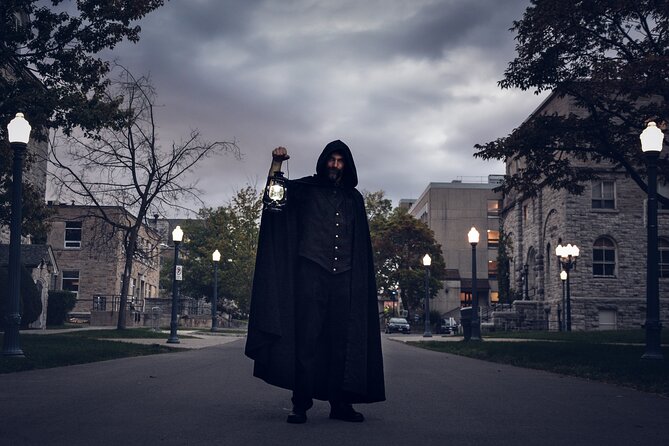
The Agnes Etherington Art Centre is one of the more surprising stops. Located on Queen’s campus, it holds more than 17,000 works of art, from ancient pieces to contemporary creations.
The museum is also said to be haunted, which gives the stop a different feel from the churches, hospitals, and old university halls. A place built for art and quiet reflection becomes part of the evening’s supernatural route.
I like the contrast. The art centre gives you a cultural landmark rather than another institutional building with a grim past. Its collection and outdoor spaces are part of what makes it worth noticing during a daytime visit, while the tour offers an entirely different way to think about the site after dark.
The stop is still story-based. You should not expect an art tour or time to examine the collection in detail. The museum matters here as a setting for one of the tour’s ghost accounts.
Dunning Hall shows that age is not everything
Dunning Hall was built in 1960, making it newer than most of the other sites. It is home to Queen’s Department of Economics and contains some of the university’s largest lecture halls.
Its place on the route makes a useful point: a building does not need to be Victorian to collect ghost stories. Dunning Hall is a lesser-known campus haunt, and its modern stone design gives the tour a break from older architecture.
You might find this stop less visually dramatic than Summerhill or Chalmers United Church. That is part of its value, though. It keeps the tour from suggesting that only ancient buildings can have eerie reputations. The story attached to Dunning Hall broadens the idea of what makes a place feel haunted.
Alfie Pierce at the John Deutsch University Centre
The final major campus story is tied to the John Deutsch University Centre. The current building was rebuilt in 1947 after the original Students’ Union building was destroyed by fire.
This is where most ghostly events linked with the spirit of Alfie Pierce are said to take place. The fire and rebuilding give the building a clear past before the ghost story begins, and the student-centre setting adds a human, social backdrop.
It is a fitting late stop because the building connects loss, reconstruction, and student life. After hearing stories from churches, hospitals, museums, and academic halls, you finish with a place built for university community.
The tour then returns to the courthouse, where the experience ends. Since the start and finish are the same, you do not need to arrange a ride from a separate location.
What $25.31 gets you
At $25.31 per person, this is reasonably priced for a 75-minute guided experience that covers a long list of Kingston sites. You are paying for the guide’s storytelling and local context, not admission to a museum, a performance, or a set of special effects.
That distinction matters. If you want actors, costumes, props, or jump scares, this may feel modest. If you want an organized evening route with stories tied to real buildings and people, the price is easier to justify.
The small group limit adds value. With a maximum of 20 people, the guide has a better chance of being heard at outdoor stops, and you are less likely to spend the evening at the back of a large crowd.
The experience is also useful for families with older children. One family booking described it as a last-minute choice that became the best activity of the vacation, with a grandson enjoying it greatly. Another account specifically found the stories suitable for children. Even so, the medical and tragic material means you should judge your child’s tolerance for spooky subjects.
Practical details for a smoother evening
The tour starts at 8:00 pm and lasts about one hour and 15 minutes. It is offered in English, uses mobile tickets, and ends at the original meeting point.
Most people can participate, and service animals are allowed. The route is near public transportation, which helps if you are staying elsewhere in Kingston.
The tour requires good weather and a minimum number of participants. If poor weather cancels the outing, you are offered another date or a full refund. The same applies if the minimum number is not met.
You can cancel for a full refund up to 24 hours before the start time. Cancellations or changes made less than 24 hours before the tour are not refunded or accepted, so watch the local cut-off time.
Who should book this Kingston ghost tour?
I would choose this tour if you enjoy old buildings, campus lore, Canadian history, and stories that are creepy without being a full horror production. It is especially appealing if you already plan to see Queen’s University and want a reason to notice buildings you might otherwise pass quickly.
Families can consider it, since the available feedback points to children enjoying the format. Still, the stories include tragedy, hospitals, death, and macabre medical practices, so very young or sensitive children may not be comfortable.
The tour is also a good fit for a short evening in Kingston. At 75 minutes, it leaves room for dinner or another night-time activity. The 8:00 pm start gives the stories a darker setting while keeping the outing reasonably compact.
You may want to skip it if you need guaranteed scares, indoor shelter, or detailed access inside every building. The experience depends on the guide, the stories, and your willingness to use your imagination.
Should you book it?
Book the Ghost Tour of Queen’s University if you want a small-group evening walk through Kingston’s institutional past, with stories tied to specific buildings rather than generic ghost folklore. The best reasons to go are the variety of stops, the unusual medical history at Summerhill and the hospitals, and the Alfie Pierce story at the John Deutsch University Centre.
At $25.31, it is a fair buy for a compact local-history experience. Go with an open mind, dress for the weather, and expect storytelling rather than a haunted attraction. That is where this tour makes its case.
FAQ
Where does the Ghost Tour of Queen’s University begin?
The tour begins at the Kingston, Frontenac County Courthouse, 5 Court Street, Kingston, Ontario, K7L 2N4.
What time does the tour start?
The tour starts at 8:00 pm.
How long does the tour last?
The tour lasts approximately one hour and 15 minutes.
Where does the tour end?
The tour ends back at the original meeting point, the Kingston courthouse.
How much does the tour cost?
The listed price is $25.31 per person.
What language is the tour offered in?
The tour is offered in English.
How large is the group?
The tour has a maximum of 20 participants.
Are service animals allowed?
Yes, service animals are allowed.
Can I cancel for a full refund?
Yes. You can cancel at least 24 hours before the local start time for a full refund. Poor weather or failure to meet the minimum number of participants may also lead to another date or a full refund.
Just added around Canada
- Victoria: Ghost Tour of Old Town and Bastion Square★ 4.7 · 70 reviews
- Vancouver: The Dark Secrets of Stanley Park Tour★ 4.9 · 34 reviews
- Winnipeg’s Most Haunted: a Smartphone Audio Ghost Tour★ 3.5 · 5 reviews
- The Haunting of Vancouver Film Tour★ 5.0 · 14 reviews
- Ghosts of the Village at Black Creek★ 4.5 · 6 reviews
- University of Toronto Ghost Tour – Campus Secrets & Spectres★ 4.5 · 13 reviews
- Haunted Walk Experience at the Mackenzie King Estate★ 4.5 · 12 reviews
- Ottawa Valley Haunted Tour – Night Trip From Ottawa★ 4.5 · 5 reviews
Canada Ghost Tours, compared.
Old Montreal: Traditional Ghost Walk of the Haunted City
Read our review →
Browse the lists this tour appears in