
REVIEW · LONDON GHOST TOURS
London – Jack the Ripper Small Group Tour
Jack the Ripper’s story is often sold as a spooky stroll through dark lanes. This 2-hour-15-minute walk with Richard Walker takes a different route, focusing on the five women, the poverty of Victorian Whitechapel, and the evidence behind competing suspects. You visit several murder sites rather than simply hearing a string of gruesome tales.
I like two things right away: the small group, limited to 15 people, and the practical audio system. Richard uses a radio microphone and earphones, so traffic and city noise should not swallow his talk. He also carries an iPad with historical images, which helps you picture streets and buildings that have changed greatly.
The main consideration is tone. This is educational and victim-focused, not a ghost tour built around gore or jump scares. You will spend some time standing while Richard explains the evidence, so wear good walking shoes and expect a brisk 1.5-mile route.
Key points to know before booking
- Richard Walker leads the walk: He brings a strong interest in the case, its suspects, and the lives of the women who were killed.
- The story begins with Emma Elizabeth Smith: The first stop is outside the former London Hospital on Whitechapel Road.
- You visit several real crime locations: Buck’s Row, Brick Lane, Spitalfields, and Dorset Street form the backbone of the route.
- Headsets make a difference: The radio microphone and earphones help you follow the guide in noisy East London streets.
- This is not a scary ghost walk: Expect history, evidence, theories, and social context more than theatrical fright.
- The finish is convenient: The walk ends near Liverpool Street Station, with access to several Underground lines and the Elizabeth line.
A victim-first look at Jack the Ripper
I find the strongest feature of this tour to be its refusal to treat the murders as a cartoon mystery. Richard gives time to the women themselves, including where they lived, how they survived, and what is actually known about their final hours.
That approach matters. Popular accounts often flatten the victims into a single label and rush toward the killer’s identity. Here, you examine assumptions about their lives and the idea that all five women were working as prostitutes. You also look at witness statements and ask how reliable they really were.
The tour still covers suspects and murder methods. Richard uses Scotland Yard’s geographical profile and an FBI profile created by Special Agent John Douglas to build theories about where the killer may have lived and how he operated. The result is less a solved puzzle than a careful look at what can and cannot be proved.
If you already know the familiar Jack the Ripper story, you may appreciate the fresh angle. If you want a dramatic, gory account, you may find the tone too restrained.
More Jack the Ripper tours in London:
- London: The Original Jack the Ripper Walking Tour
★ 4.7 · 7,833 reviews - London Jack the Ripper Guided Tour with Ripper-Vision
★ 4.5 · 4,840 reviews - London: Jack the Ripper Small Group Tour
★ 4.7 · 3,159 reviews
Whitechapel Road and the death of Emma Elizabeth Smith
The meeting point is at 279 Whitechapel Road, opposite the London Hospital. The tour begins at 7 p.m., when the modern street is still active rather than deserted. That contrast helps you think about the district as a real neighborhood, not a stage set.
Richard starts with Emma Elizabeth Smith, described here as the first victim of the Whitechapel Murders. She died after being brutally attacked on April 3, 1888. The opening section takes about 10 minutes and sets up the central question of the evening: who were these women, and why did the murders become linked?
This is a useful beginning because it places the case in its social setting. Whitechapel was a poor East London district with overcrowded housing and large numbers of people living close to the edge. The tour does not treat poverty as background decoration. It explains how the neighborhood shaped the victims’ choices and the police investigation.
Buck’s Row and the first murder scene
From Whitechapel Road, you continue to Buck’s Row, now within Whitechapel. This is where Polly Nichols was killed, and Richard presents it as a crime-scene investigation rather than a quick photo stop.
You examine when, where, and how the murder may have happened. The physical setting has changed, but the location gives the case a useful sense of scale. You can better understand how quickly an attack might have occurred and why questions about silence, visibility, and witness testimony matter.
This is also where the first suspect is introduced. Richard does not simply announce a culprit and move on. He explains how a suspect fits, or fails to fit, the known facts. That method gives the tour a more analytical feel than the standard list of suspects.
Plan to listen closely here. The route is not built around constant movement. Richard may spend a sustained period explaining the evidence at one spot, which some people appreciate and others find tiring.
Brick Lane, lodging houses, and a second theory
The walk continues toward Brick Lane, now famous for curry restaurants and East London food culture. In 1888, this area had a far harsher character. Brick Lane also marks the eastern boundary of the area where all five victims lived at the time of the murders.
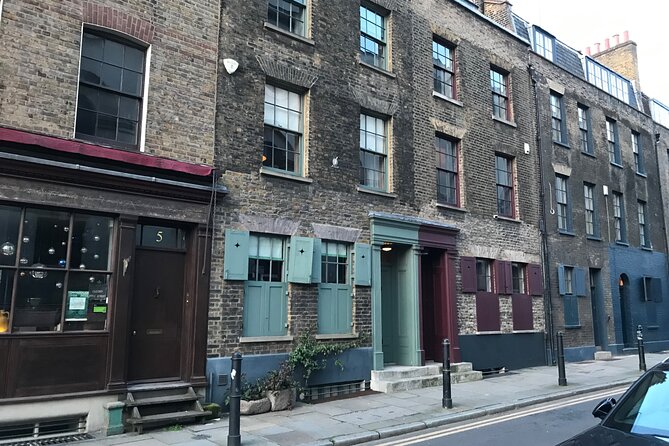
Richard points out the streets connected with the women, including Thrawl Street, where Polly Nichols stayed at Wilmott’s Lodging House. Flower and Dean Street is linked to the third and fourth victims, and the tour discusses the police belief that the killer may have lived nearby.
Annie Chapman, the second victim, was found murdered close to Brick Lane. Her case gives Richard another opportunity to explain the evidence and introduce a second suspect. This theory draws on both the Scotland Yard geographical profile and an FBI profile, making the discussion useful for anyone interested in criminal investigation rather than folklore alone.
Brick Lane is also one of the more enjoyable parts of the route because the modern neighborhood is full of life. Restaurants, shops, and traffic make it impossible to pretend the area has remained frozen in 1888. That is a strength, not a weakness. You see how an ordinary London district can carry layers of difficult history without looking like a museum.
A few more ghost walks around London worth a look
- Ghost, Ghouls and Gallows Tour : Guided Tour with Boat Ride
★ 4.5 · 3,212 reviews - London Jack The Ripper Guided Walking Tour
★ 5.0 · 3,131 reviews - London: Comedy Horror Ghost Tour on a Bus
★ 4.4 · 2,084 reviews - London: Jack the Ripper Tour with Immersive Ripper Vision
★ 4.5 · 1,840 reviews
Christ Church Spitalfields and the Ten Bells
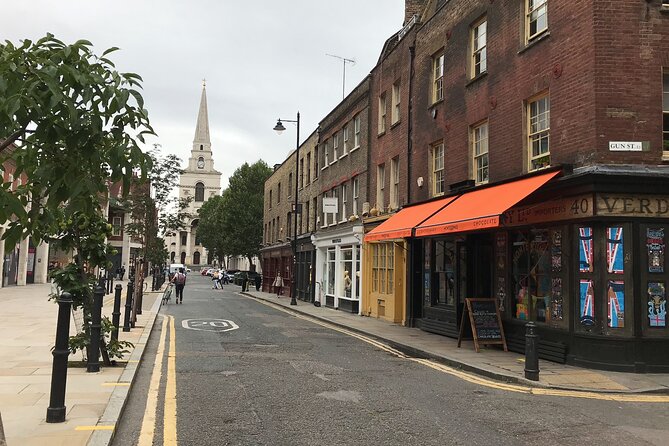
Christ Church Spitalfields provides one of the route’s clearest architectural moments. The church was designed by Nicholas Hawksmoor and faces the Ten Bells pub, whose name refers to the church bells across the street.
The pub is tied to the story because the women visited it. Richard uses this stop to explain how the pub, church, streets, and lodging houses formed part of daily life in the district. The building itself is worth noticing even if you have only a passing interest in the murders.
Admission to the church is not included, and the tour does not present an interior visit as part of the route. You view the exterior and hear its place in the story. This is a good example of how the walk adds London history around the central mystery.
Some of the most useful context comes from these ordinary places. A church, pub, market, and lodging house tell you more about the neighborhood than a sequence of sensational crime details. You begin to see the murders as events within a functioning community.
Old Spitalfields Market and Victorian poverty
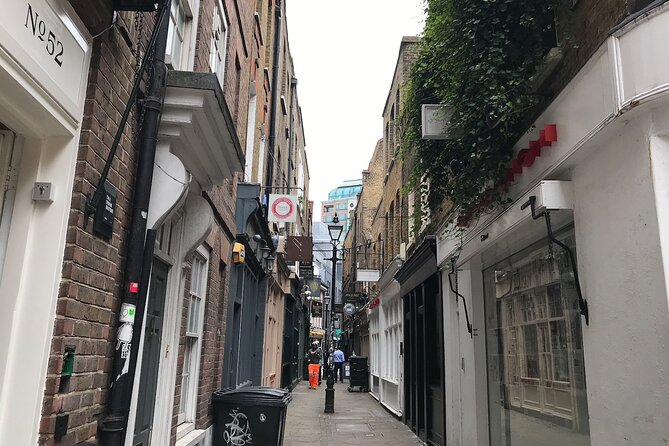
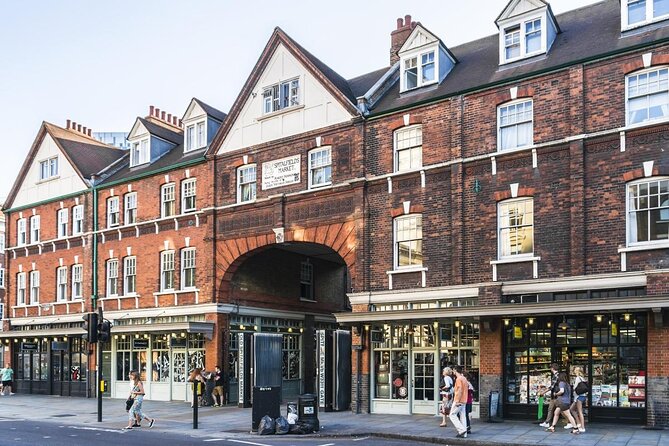
Old Spitalfields Market is another major setting. It has served as a community market for centuries, and the tour connects it with the poverty described by American writer Jack London, who witnessed appalling conditions in Victorian London.
This stop broadens the subject beyond the identity of the killer. You consider the working people, housing conditions, and social divisions that shaped Whitechapel. The market is also a natural place to pause and take in how much the district has changed.
The modern market area is not a preserved crime scene. That makes Richard’s iPad particularly helpful. Historical images can show you what the streets and buildings looked like when the murders took place, giving the talk a visual anchor.
If you prefer a tour that moves constantly from one landmark to another, this section may feel slow. The value comes from the explanation, not from a large number of sights. You are here to understand the setting, not collect postcard views.
Spitalfields, Dorset Street, and Mary Kelly
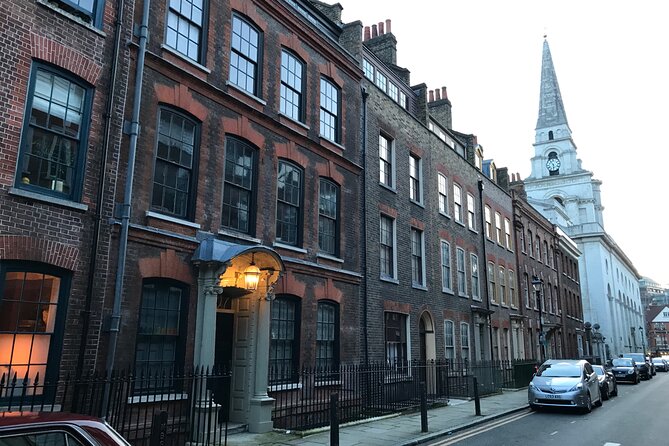
The final part of the walk takes you into Spitalfields, including the area associated with what was described as the worst street in London. Annie Chapman lived here until the night she was murdered, and Mary Kelly also lived and died in this part of the district.
Mary Kelly receives particular attention because she was a different kind of victim from the others. Her story leads to a third convincing suspect and gives Richard another chance to question familiar assumptions about the case.
This section also helps explain why geography matters. The murders were not scattered randomly across London. The close connections between homes, lodging houses, pubs, and crime scenes support theories about the killer’s movements and home territory.
The route ends at 126A Middlesex Street, near Liverpool Street Station. That is practical after an evening walk. The station serves the Central, Circle, Hammersmith and City, and Metropolitan lines, along with the Elizabeth line.
What Richard Walker adds to the experience
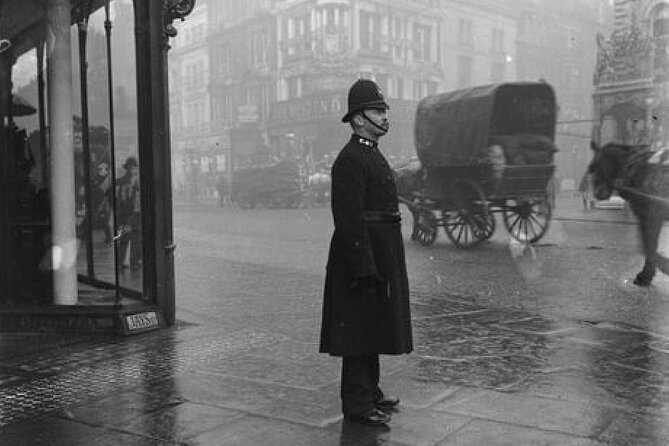
Richard’s strength is his preparation and enthusiasm. He clearly enjoys examining the details, and he presents the material with energy rather than reading a fixed script in a flat voice. His approach is especially useful if you want more than the standard suspects and familiar legends.
He also makes room for disagreement. One particularly interesting aspect is the way he questions accepted claims about the victims, eyewitness testimony, and the assumption that every woman was definitively working as a prostitute. You are encouraged to separate evidence from repetition.
The iPad images help with this. A photograph or historical illustration can make an explanation of a street, building, or victim easier to follow. The headsets are just as important. East London is not silent at night, and the audio system means you do not need to crowd around Richard to hear him.
The small group is another real advantage. With a maximum of 15 people, you have a better chance to ask questions than on the large Jack the Ripper walks that move through the same district. The exact number can vary, and a full group will not feel private, but it should remain more manageable than a crowd of 30 or 40.
Walking pace, comfort, and the evening schedule
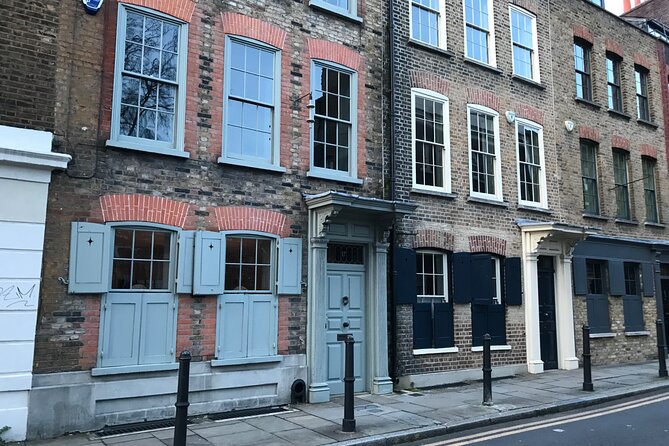
The route covers about 1.5 miles, or 2.5 kilometers. That is not a major hike, but the evening includes periods of standing and a brisk walking pace. The tour specifically requires a moderate level of physical fitness and is not suitable for people with walking difficulties.
Wear comfortable shoes. You may also want a coat suitable for London weather, since the experience takes place outdoors at night. The schedule begins at 7 p.m. and lasts about 2 hours and 15 minutes, so plan for a late finish.
The tour is offered in English and includes a mobile ticket. Coffee and tea are not included. The walk is near public transportation at both ends, which makes it easy to fit into an evening in East London.
The cancellation terms are strict: the experience is non-refundable and cannot be changed after booking. I would only reserve it once your evening plans are firm.
Is $41.67 a fair price?
At $41.67 per person, this is not the cheapest way to hear about Jack the Ripper. The value comes from the small group, the length of the walk, the audio equipment, the visual material, and the guide’s focused research.
You are also paying for a route that links four murder sites with the surrounding streets and social history. A cheaper walk may cover the same district, but it may not offer the same group limit or equipment. The headsets are especially useful if you are concerned about missing details.
I would consider the price fair for someone who wants a serious, guided investigation of the case. It is less appealing if you mainly want a short, theatrical night walk with spooky storytelling.
This experience is often booked well in advance, with an average booking time of 54 days. That suggests you should not leave it until the last minute if the Thursday or Friday schedule fits your plans.
Who should book this walk?
I would choose this tour if you enjoy true crime, social history, or the process of weighing evidence. It suits people who want to understand Whitechapel and Spitalfields as neighborhoods, not just visit famous murder locations.
It also works well for families with older children who can handle serious subject matter. The tone is not especially frightening, and the focus is more on facts, people, and theories than on graphic detail.
You may want a different experience if your main goal is atmosphere, theatrical suspense, or gruesome descriptions. The guide talks about murder and poverty, but he does not build the evening around shock.
The walk is also a good match for visitors who have already read about the case. Richard challenges several common assumptions, so you are likely to hear ideas beyond the familiar story of a mysterious man in a top hat.
Should you book the Jack the Ripper Small Group Tour?
Book it if you want victim-centered history, careful theories, and a genuinely small group. Richard Walker’s use of headsets and iPad images makes the talk easier to follow, while the route connects Whitechapel’s streets with the people who lived and died there.
Skip it if you want a ghost tour or a heavily gory account. This is a thoughtful walking lecture with crime-scene elements, not a horror show. For the right audience, the combination of real locations, Victorian context, and competing suspects offers a much better understanding of why the case still holds London’s attention.
FAQ
How long does the Jack the Ripper Small Group Tour last?
The tour lasts approximately 2 hours and 15 minutes.
Where does the tour begin?
It begins at 279 Whitechapel Road, London E1 1BY, opposite the London Hospital.
Where does the tour finish?
The walk ends at 126A Middlesex Street, near Liverpool Street Station.
What time does the tour start?
The stated start time is 7 p.m.
How many people can join the tour?
The maximum group size is 15 people.
Is the tour suitable for people with limited mobility?
The tour requires moderate physical fitness, includes about 1.5 miles of walking, and is not suitable for people with walking difficulties.
Just added around London
- Wicked Whitechapel: Where Now’s Jack The Ripper Audio Tour★ 5.0 · 2 reviews
- Ghosts, Gore & Other Ghasty Stories in the City of London★ 5.0 · 7 reviews
- Visit Jack the Ripper in French★ 5.0 · 33 reviews
- The Ghosts of the secret alleyways of old London town★ 5.0 · 2 reviews
- The Haunted Pubs of Old London: Small Group Tour★ 5.0 · 38 reviews
- Afternoon Jack the Ripper : Guided Tour★ 5.0 · 183 reviews
- The Fading Light London Ghost Walk★ 5.0 · 35 reviews
- Self-Guided Audio Tour-Behind the shadow of evil: Jack the Ripper★ 4.0 · 2 reviews
London Ghost Tours, compared.
London Jack the Ripper Guided Tour with Ripper-Vision
Read our review →
Ghost, Ghouls and Gallows Tour : Guided Tour with Boat Ride
Read our review →
Jack the Ripper Tour with Immersive Ripper Vision
Read our review →
German Language : Original Jack the Ripper Tour
Read our review →Browse the lists this tour appears in