
REVIEW · DARK HISTORY & TRUE CRIME TOURS
Brutal Tbilisi — Night Edition: Dark Side of Soviet Architecture
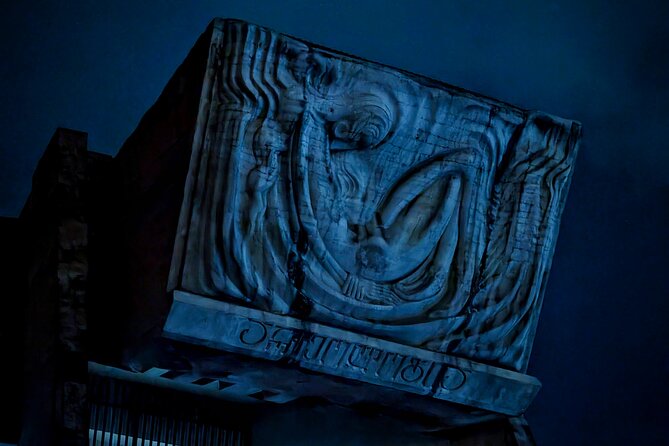
Tbilisi’s Soviet architecture looks different after sunset. Concrete towers, abandoned stairways, glowing bridges, and huge carved monuments take on a quiet, almost theatrical mood. This private night tour connects six of the city’s most unusual sights, including places that are difficult to reach on your own.
I like the strong photo opportunities and the way the route moves beyond the usual Old Town circuit. I also like the private transport, since these sites are spread across Tbilisi and public transport would make the evening slower and less convenient.
The main drawback is the tone. This is not a gentle sightseeing outing. You may encounter dark, unfinished spaces, uneven ground, old elevators, high viewpoints, and stories of war and displacement. If heights, claustrophobia, or emotionally heavy subjects bother you, choose a more conventional evening tour.
Six reasons this night tour is different
- Arashenda’s unfinished hotel frame reveals how political change turned an ambitious Soviet project into a place of shelter.
- The Chronicles of Georgia after dark offers towering carvings, golden light, and wide views over Tbilisi Sea.
- The former Archaeology Museum gives you a glimpse of an abandoned 1988 project with temple-like stairs and weathered stone figures.
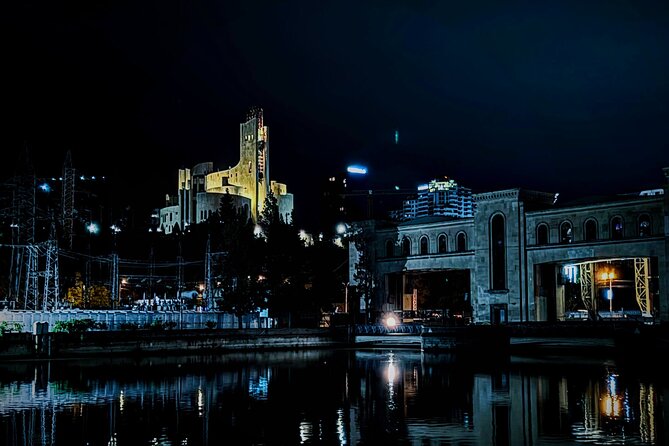
- The Highway Ministry building is a remarkable piece of concrete design that now serves as Bank of Georgia headquarters.
- Nutsubidze Skybridge combines a rare Soviet housing design with an old elevator and high night views.
- The Wedding Palace shows how Soviet Georgia replaced religious ceremony with a grand civic ritual.
Why Tbilisi’s Soviet architecture works at night
This experience is built around mood as much as information. During daylight, these buildings can look like unusual examples of late Soviet design. At night, limited lighting and empty surroundings sharpen their shapes. A broad stairway feels more monumental. A suspended bridge appears to float. A half-finished tower becomes a reminder of lives interrupted.
You are not simply ticking off famous sights. You are looking at how architecture reflects political ambition, economic failure, war, religion, and daily life. The guide’s job matters here, because several locations are more striking than self-explanatory. Without context, you might see only concrete and shadows.
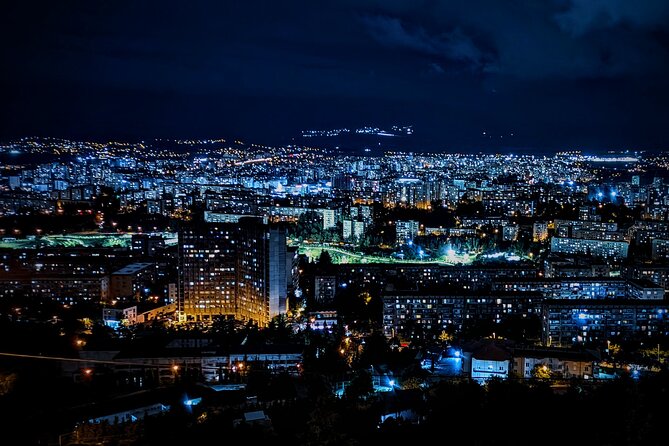
The route also gives you a view of Tbilisi far beyond the central streets. You will travel to Digomi, Nutsubidze Plateau, the Tbilisi Sea area, and other outer districts. That makes the private car a practical part of the tour, not just a comfort.
The experience lasts about three to four hours. The listed visits add up to roughly two hours and 50 minutes, with the remaining time used for driving, pickup, orientation, and photography. Traffic, rain, snow, and city events can change the order or length of stops.
More dark history tours in the world:
- Adults-Only New Orleans Ghost, Crime, Voodoo, and Vampire Tour
★ 5.0 · 6,545 reviews - Edinburgh: Dark Secrets of the Old Town Ghost Walking Tour
★ 4.6 · 1,671 reviews - New Orleans Adults-Only True Crime and Ghost Walking Tour
★ 5.0 · 1,666 reviews
Arashenda Building: an unfinished hotel turned refuge
The Arashenda Building is one of the most affecting stops because its story is tied to ordinary people. Construction began in the early 1980s, when the building was intended to become the grand Hotel Odishi. The project never reached completion as Georgia went through political upheaval and civil conflict.
The seventeen-story concrete frame later became shelter for families displaced by war. That changes how you read the building. Its folded wings may resemble an open book, but the important story is not just the unusual design. It is the way an abandoned state project became a vertical community.
At night, cracked walls and improvised balconies create a severe but compelling scene. Your guide explains why locals call it Arashenda, meaning the one that did not get built, and connects the structure to both its unfinished past and its human use.
You will have about 20 minutes here. The visit is free, and the best views may come from the open stairways or surrounding viewpoints rather than from entering every part of the building. Expect a dark, rough setting, not a polished monument. From the area, you can also see the Chronicles of Georgia, creating a striking contrast between an official monument and a place shaped by loss and survival.
Chronicles of Georgia: monumental stone above Tbilisi Sea
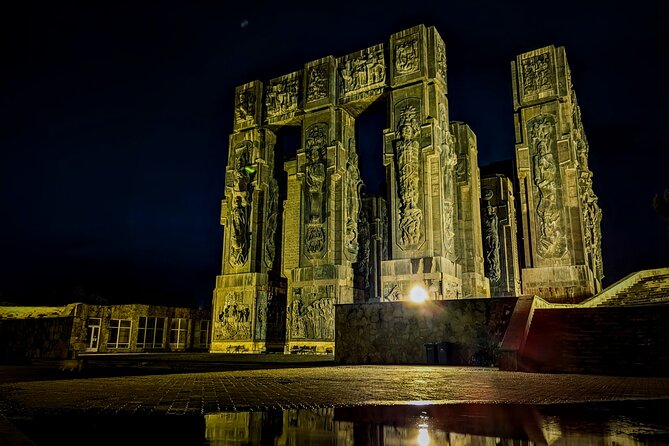
The Chronicles of Georgia is the grandest visual stop on the route. Huge columns rise above the city, carved with figures connected to Georgia’s kings, saints, and Christian tradition. In daylight, the scale is impressive. At night, soft golden lighting and black gaps between the columns give the monument a far more dramatic character.
You will spend about 45 minutes walking among the carvings while your guide explains the imagery and stories attached to the site. The monument is often quiet after dark, which helps you take in its size without a crowd pressing around you.
The top platform provides views across Tbilisi and the dark water of Tbilisi Sea. Bring a phone or camera with a night mode, but do not assume the darkness will solve every photography problem. A guide who knows where to place you and how to use available light can make a real difference. The tour specifically includes photo tips, and the company’s guides, including Alex, Oksana, Jonah, and Aleski on other city experiences, have been praised for combining local explanation with picture-taking help.
This is also a good place to ask questions. The carved scenes can be hard to interpret without help, and the guide can explain the difference between what the monument was designed to express and how it feels to encounter it today.
The former Archaeology Museum on Digomi Hill
The former Archaeology Museum has a more solitary mood. Built in 1988 to preserve Georgia’s ancient treasures, it never fully opened. Its position on Digomi Hill gives it a commanding presence, but the building’s unfinished or abandoned character is the main attraction.
The broad stairs resemble the entrance to an ancient temple. Weathered bas-reliefs appear in the low light, linking the modern structure to Georgia’s distant past. The result is strange: a building meant to protect archaeological objects now functions as an object of architectural archaeology itself.
The stop lasts about 20 minutes. You should think of it as a photo and storytelling visit, not a museum admission. There is no indication that the interior operates as a public museum, so the value comes from the exterior, the setting, and the explanation of how changing political conditions affected the project.
This stop may appeal most to you if you like unfinished buildings and places that reveal a city’s unrealized plans. It may feel brief if you prefer active interiors or formal exhibits.
More evening tours in the world:
- Haunted Evening Horse and Carriage Tour of Charleston
★ 4.5 · 3,678 reviews - Edinburgh: Evening Underground Ghost Tour
★ 4.4 · 3,092 reviews - Prague: Ghosts and Legends of the Old Town Evening Tour
★ 4.5 · 3,091 reviews - Ghosts of Charleston Night-Time Walking Tour with Unitarian Church Graveyard
★ 4.5 · 2,835 reviews
The former Ministry of Highways and its floating concrete blocks
The former Ministry of Highways building is one of Tbilisi’s best-known examples of daring Soviet architecture. Designed in the 1970s, it consists of massive concrete blocks arranged like bridges suspended over the hillside. The design was meant to suggest the unity of Georgia’s mountain roads.
Today, the building houses Bank of Georgia headquarters. That modern use adds an interesting layer. This is not simply a ruined Soviet relic. It remains part of working Tbilisi, with a new institution occupying a building created for a different political era.
At night, the voids between the blocks and the lit corridors create the building’s strongest effects. You will spend around 20 minutes here, with the guide showing you useful angles for photographs and explaining the design.
Do not expect a long interior visit. The attraction is the exterior form, viewed from the right position. Because the structure is large and unusual, a guide is especially useful for helping you understand how its pieces fit together. The stop also works well as a reminder that Soviet architecture was not always dull or repetitive. Some of it was bold, theatrical, and technically ambitious.
Nutsubidze Skybridge and the old elevator ride
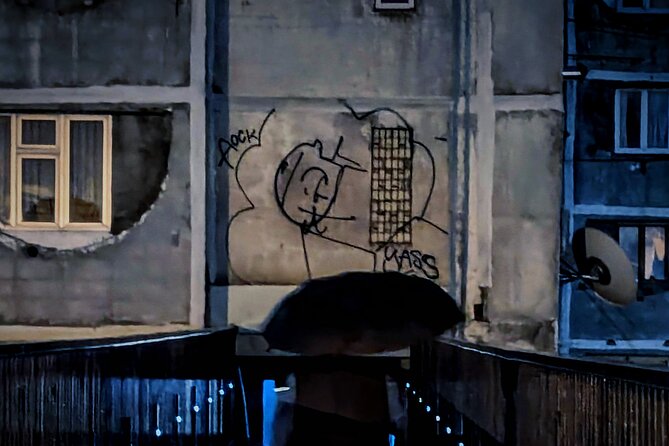
The Nutsubidze Skybridge is the route’s most unusual encounter with everyday Soviet housing. Three large residential blocks on Nutsubidze Plateau are connected by suspended bridges. From ground level, the scale can be hard to grasp. Once you rise into the complex, the design becomes clearer.
The evening visit lasts about 45 minutes. The corridors glow faintly, while Tbilisi’s lights flicker below. The bridges were designed as practical connections between residential blocks, but at night they can feel like walkways suspended in open air.
Part of the appeal is the old elevator. You ride it with the help of a lift attendant, often called the lift lady, who has operated the system through generations of local life. This small human detail keeps the stop from becoming only an architecture lesson. It shows how an ambitious design is maintained and used by real people.
The skybridge is also the clearest place to consider your comfort level. You may encounter heights, narrow or enclosed passages, and an aging lift. The tour specifically warns against joining if you fear heights or claustrophobic spaces. Wear stable shoes, pay attention to the guide, and do not rush your photographs.
The views stretch across modern towers, older districts, and distant hills. You get a useful sense of Tbilisi as a layered city, not just a historic center surrounded by anonymous suburbs.
Arcadia Georgia, Tbilisi’s surreal Wedding Palace
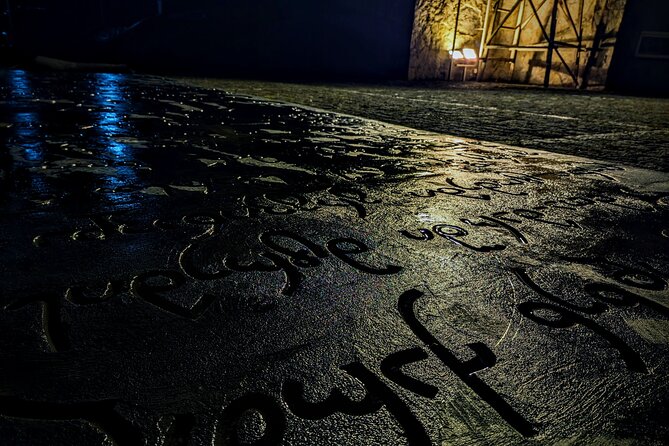
The final stop is the Wedding Palace, also known as the Palace of Rituals. Designed by Victor Jorbenadze and completed in 1984, it was created for civil wedding ceremonies during the Soviet period. Couples could mark a major life event in a ceremonial building without a church service.
The architecture is unusually expressive. Its arches and spiraling form recall Georgian religious buildings, yet the material and scale belong to late Soviet modernism. There are also echoes of Le Corbusier’s sculptural approach, though the building has a distinctly Georgian sense of ceremony.
At night, light from the interior passes through the curved openings and creates a romantic, slightly strange atmosphere. That contrast is what makes the building memorable. It was designed within a system that limited religious practice, yet it still used ritual, symbolism, and a sense of awe.
You will spend about 20 minutes here. The visit is mainly about the exterior form and the story behind it. If you are interested in how governments shape public rituals, this may be the most thought-provoking stop on the route. If you want a conventional wedding venue tour, it may feel too brief.
Photography help that is actually useful
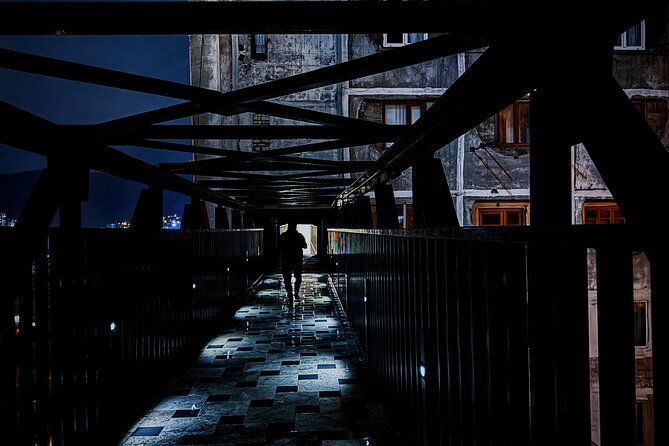
The tour is a good match for you if you want more than snapshots taken from the roadside. The guide is expected to help with angles and explain what your phone camera can do, including how to work with difficult night lighting.
You should bring a fully charged phone or camera and enough storage space. A small tripod is not mentioned as part of the service, so do not count on one being supplied. Night scenes often look better when you keep the phone steady, use available light carefully, and avoid bright flash that flattens the architecture.
The photography element is also practical for solo visitors. Guides on the company’s other city experiences have taken photos for people at major and lesser-known locations. The exact arrangement for this particular private tour is not specified, so ask at booking if you want the guide to take portraits as well as give camera advice.
Is $100 per person good value?
At $100 per person, the price is not a bargain sightseeing bus fare. It includes a private tour, door-to-door pickup within central Tbilisi, private transportation, a live local English-speaking guide, and photography tips. Admission is free at the listed stops, and meals are not included.
The value depends heavily on group size. A solo visitor pays the full per-person rate, while group discounts may make the price more attractive for two or more people. You are paying mainly for the route, transport, access to local context, and the time saved connecting distant parts of the city.
I think the price makes the most sense if you care about architecture, night photography, or unusual places that are awkward to reach without a car. It makes less sense if you only want famous central landmarks or a cheap introduction to Tbilisi.
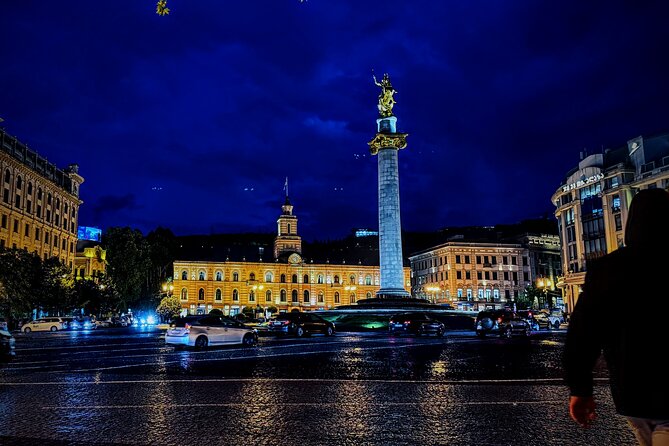
Pickup is available from central hotels and apartments. If you are outside the service area, the suggested meeting points are Liberty Square or Europe Square, near the vintage tram-café. The guide or driver contacts you on WhatsApp on the day of the tour.
Who should book this experience?
Book it if you enjoy modern architecture, difficult stories, photography, and places that feel different from standard sightseeing. It suits visitors who have already seen central Tbilisi and want to understand the city’s outer districts and Soviet-era planning.
It is also useful for people who prefer a private pace. The guide can spend more time at a favorite site, adjust the order when traffic changes, and help with camera angles without a large group waiting.
Think twice if you need smooth paths, bright interiors, or a relaxed food-and-wine evening. The experience can include uneven ground, long drives, dark spaces, high viewpoints, and emotionally charged accounts of displacement and political change. It operates in rain or snow, so dress for the forecast and wear comfortable shoes.
Should you book Brutal Tbilisi at night?
You should book this tour if you want the side of Tbilisi that is bold, unfinished, strange, and hard to arrange independently. The Arashenda Building and Nutsubidze Skybridge offer the strongest human and architectural stories, while the Chronicles of Georgia and Wedding Palace provide the most dramatic photographs.
I would choose it as a second or third Tbilisi experience, not as your only introduction to the city. For a private group willing to pay for transport and a local guide, the route offers real value. For anyone uneasy with heights, confined spaces, or heavy historical subjects, choose a lighter city walk instead.
FAQ
How long does Brutal Tbilisi, Night Edition, last?
The experience lasts approximately three to four hours. The order and timing can change because of traffic, weather, or special events, but the key sites and viewpoints remain part of the tour.
What is included in the price?
The price includes a live local guide, private transportation, and photography tips. Meals are not included, and admission to the listed stops is free.
Is hotel pickup available?
Door-to-door pickup is available within central Tbilisi. If your accommodation is outside the pickup area, you will be offered a nearby meeting point, usually Liberty Square or Europe Square.
Is this a private tour?
Yes. Only your group participates in the activity.
Is the tour suitable for people afraid of heights or enclosed spaces?
No. The experience is not recommended for people with a fear of heights or claustrophobia because it includes the Nutsubidze Skybridge and an old elevator, along with dark or uneven settings.
What happens if it rains or snows?
The tour operates in all weather conditions, including rain and snow. Comfortable shoes and suitable clothing are recommended.
Just added around the world
- Zion: Harry Potter-Inspired Zion Ghost Tour with Sunset View★ 5.0 · 8 reviews
- Your evening in Venice – Legends&Ghosts&Aperitif★ 4.7 · 79 reviews
- York’s Haunted Heart : Ghost, Ghouls and Gallows★ 4.6 · 82 reviews
- York : Private Ghost Hunt★ 5.0 · 3 reviews
- Witches, Widows, & Wraiths: Wichita Ghost Tours★ 5.0 · 2 reviews
- Wraiths & Wicked Whispers: Wilmington Ghost Tour★ 4.2 · 25 reviews
- Wraiths of the West Texas Wind: El Paso Ghost Tour★ 4.5 · 9 reviews
- Witches, ghosts and executioners / Mystical North Hesse★ 4.4 · 4 reviews
Dark History & True Crime Tours, compared.
Adults-Only New Orleans Ghost, Crime, Voodoo, and Vampire Tour
Read our review →
The Deathly Dark Tour of York: Experience of the Year 2024
Read our review →
The Dark Side of Florence: Mysteries and Legends
Read our review →
Dark Secrets of the Old Town Ghost Walking Tour
Read our review →
New Orleans Adults-Only True Crime and Ghost Walking Tour
Read our review →
Genteel and Bard’s Savannah Dark History and Ghost Encounter Walking Tour
Read our review →
Buda Castle District Dark History, Legends and Vampire Night Tour
Read our review →Browse the lists this tour appears in