
REVIEW · OXFORD GHOST TOURS
Oxford: Twilight Ghost Tour
Oxford’s old streets take on a different character after sunset. At Martyrs Cross, where bishops were burned during Bloody Mary’s reign, the tour sets its tone at once: this is not just a collection of spooky tales, but a walk through Oxford’s grim past, told beside the places where it happened.
I like the strong mix of history and ghost stories, and I like that the route reaches corners you might miss on a daytime college visit, including Dead Man’s Walk and Magpie Lane. The guides also make a difference. Simon, Tom, Jonathan, Ajai, and others have been praised for clear, theatrical storytelling. The main drawback is simple: the tour normally does not enter the colleges, and the 75 minutes can feel brisk if you want long architectural stops.
Key points at a glance
- Martyrs Cross begins the story: Hear about the bishops burned alive under Queen Mary I.
- Dead Man’s Walk adds atmosphere: Follow the ancient walls and the tale of its eternal spectral guard.
- Magpie Lane brings the local ghost lore: Listen for the poltergeist said to haunt one of Oxford’s most talked-about streets.
- History comes with the horror: The route covers murders, executions, university life, and unsolved mysteries.
- Literary Oxford appears along the way: Connect the streets with Tolkien, C.S. Lewis, Oscar Wilde, Philip Pullman, Shakespeare, and Harry Potter.
- A guide-led performance matters: Guides such as Simon, Tom, Jonathan, Eleanor, and Ajai have been praised for humor, timing, and dramatic delivery.
Why Oxford works so well after dark
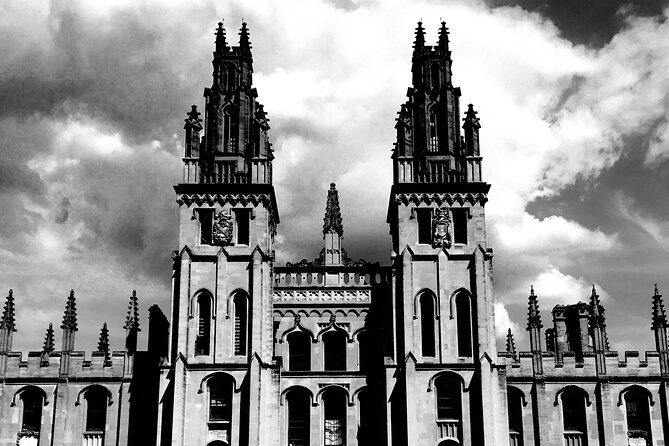
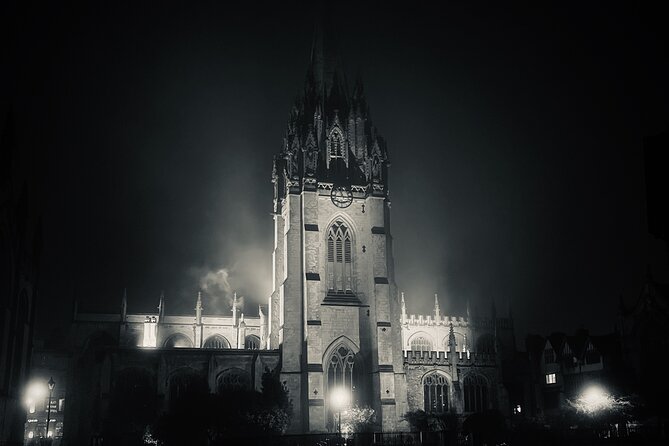
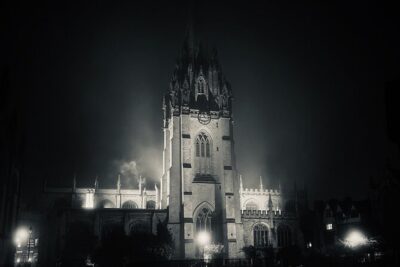
Oxford is an easy city to recognize by day. You see honey-colored stone, grand college gates, towers, and busy pedestrian streets. After twilight, the same setting feels more secretive. Narrow lanes grow darker, old walls seem higher, and the university’s age becomes more than a backdrop.
That is the real appeal of this experience. You are not simply hearing a ghost story in a room. You are walking to the spot where a punishment took place, following a lane with a sinister local tale, or pausing near buildings linked with centuries of university life.
I would not book this expecting a horror attraction. There are no stated special effects or staged scares. The mood comes from the hour, the architecture, the guide’s voice, and the stories themselves. One family described it as fun rather than too frightening, while another guide used screams and humor to keep the evening lively. That makes it suitable for many children and teenagers, though very young children may find the themes of burning, murder, and execution too heavy.
A few more ghost walks around the UK worth a look
- Oxford Official Ghost Tour
★ 4.3 · 41 reviews - Ghost Tour of Oxford
★ 4.5 · 30 reviews - Oxford Official Ghost Tour
★ 4.5 · 21 reviews
Martyrs Cross and the brutal Tudor opening
The tour begins at Martyrs Cross, the most historically serious stop on the route. Here you hear about the Protestant bishops Hugh Latimer, Nicholas Ridley, and Thomas Cranmer, who were burned during the reign of Mary I, often called Bloody Mary.
The exact point matters because the history is not abstract. You are standing where the executions took place. The guide uses the setting to explain the religious conflict behind the killings and the warning these deaths were meant to send.
This opening also tells you what kind of tour you have chosen. The ghosts grow out of real suffering, political fear, religious conflict, and punishment. The supernatural material comes after the documented history, so you get a better sense of why Oxford has collected so many dark stories over the centuries.
Give yourself a moment to take in the surroundings before the guide moves on. The tour covers a fair amount of ground in 75 minutes, and the first stop can pass quickly if you are focused only on taking photographs.
Through Oxford’s oldest streets and university quarters
From Martyrs Cross, you move through old streets and alleys in the medieval heart of Oxford. The route is designed to show you more than the postcard view of the university. You pass historic buildings, street lamps, narrow passageways, and places connected with college life and famous writers.
The guide may also point out locations linked with Shakespeare, C.S. Lewis, J.R.R. Tolkien, Oscar Wilde, Philip Pullman, and Harry Potter. These references broaden the tour beyond ghosts. Oxford becomes a place where religious martyrs, scholars, fictional characters, and modern film audiences all overlap.
One useful feature is the amount of general Oxford information folded into the walk. Several guides have explained college life, university buildings, and the city’s past alongside the supernatural stories. That is good value if this is your first visit, or if you know Oxford mainly from a college tour and want a different angle.
The limitation is that the evening route normally stays outside the colleges. You can admire their gates, walls, and exteriors, but you should not book this as an interior university tour. College access varies, and the activity information specifically warns that the colleges are usually closed in the evening.
Dead Man’s Walk and the eternal sentry
Dead Man’s Walk is one of the tour’s most atmospheric locations. The name alone sounds like a piece of folklore, but the guide also connects it with Oxford’s old walls and a spectral soldier said to guard them forever.
This is where the darkness does much of the work. You follow the route near ancient defenses while the story turns the wall into a boundary between ordinary Oxford and something less settled. It is a memorable stop because the setting supports the tale. You are not being asked to picture a random haunted house. The ghost belongs to a particular place with a military and civic past.
The guide’s presentation is important here. A flat reading would lose the mood, but the best guides use pauses, changes in tone, and small details to make the story land. Tom has been described as theatrical, while Jonathan was praised for his storytelling and Oxford background. Simon has also been singled out for keeping the group engaged while adding useful context.
Expect to keep walking after the story. This is not a stop-and-start lecture with long breaks. The route moves at a steady pace, which lets you cover several parts of central Oxford within the allotted time.
Same streets after dark, a different sort of fright:
- The World Famous Underground Ghost Tour
★ 4.5 · 9,272 reviews - London: The Original Jack the Ripper Walking Tour
★ 4.7 · 7,833 reviews - Edinburgh: Haunted Underground Vaults and Graveyard Tour
★ 4.6 · 6,607 reviews - London Jack the Ripper Guided Tour with Ripper-Vision
★ 4.5 · 4,840 reviews
Magpie Lane and the poltergeist story
Magpie Lane supplies the tour with one of its more playful pieces of local folklore. The story centers on an anguished poltergeist, and the guide may share personal or reported eerie experiences connected with the street.
This stop shows the balance of the experience. The subject matter can be macabre, but the tone is often humorous. Guides have used jokes, dramatic timing, and audience interaction to keep the group relaxed. You may hear a scream, but you are just as likely to hear laughter.
The street itself is part of the attraction. Oxford has many famous sights, yet the smaller lanes give you a better feel for the city’s old layout. You should keep your attention on the guide rather than trying to rush ahead for photos. In a group, the story is easier to follow when everyone stays close enough to hear.
If you are hoping for hard proof of the supernatural, this stop will not provide it. The value lies in the local tradition, the setting, and the way the guide connects folklore with Oxford’s long memory.
Literary ghosts, real writers, and film connections
The tour also works as a compact introduction to Oxford’s literary identity. The city’s dreaming spires have inspired writers and hosted fictional figures, and the guide uses those connections to add another layer to the evening.
You may hear about J.R.R. Tolkien and C.S. Lewis, whose Oxford lives and friendships have become part of the city’s literary mythology. The route also touches on Philip Pullman, Oscar Wilde, Shakespeare, and Harry Potter. One guide pointed out locations associated with Tolkien, Lewis, and Rowling, as well as places connected with Shakespeare and C.S. Lewis’s personal life.
These references are useful if you are traveling with someone who is less interested in ghost lore. A teenager may care more about Harry Potter than a medieval execution. A reader may be drawn in by Tolkien or Pullman. Someone interested in university history may prefer the college stories. The tour gives each interest a place without becoming a formal literary walk.
Keep your expectations measured. The experience does not promise access to private college interiors or a full treatment of each author. Think of the literary material as a series of well-placed connections within a ghost walk.
The guides make or break the evening
The strongest praise for this experience centers on the guides’ delivery. That makes sense. Ghost tours depend less on equipment than on voice, timing, clarity, and the ability to read a group.
The guide roster varies, so you may meet Simon, Tom, Jonathan, Ajai, Eleanor, Sophie, Ollie, Ali, Magnus, Jeremy, Max, or another member of the team. Simon has been praised repeatedly for his Oxford knowledge and easy humor. Tom is known for a theatrical approach, while Jonathan has drawn attention for his background as a former Oxford student and his ability to explain college life.
Eleanor has been praised for being articulate and easy to hear, a real advantage on a busy street. Jeremy’s presentation has been described as carefully timed, and Ajai has been noted for mixing information with humor. These details matter because a 75-minute walking tour can become tiring if you cannot hear the story or if the guide spends too long on one point.
You cannot choose the guide from the information available, so book this for the format and route rather than for one specific person. Still, the repeated emphasis on storytelling suggests that the company treats presentation as a central part of the experience.
How much ground you cover in 75 minutes
The tour lasts 75 minutes, which is long enough to visit several atmospheric areas but short enough to fit before dinner or another evening plan. One guide covered a lot of ground in that time, and another tour ran slightly longer than advertised, though you should plan around the stated 75 minutes rather than count on extra time.
The pace has generally been described as comfortable. You will walk through streets and lanes, stop for stories, and continue to the next location. Oxford’s central streets are manageable on foot, but the tour is still outdoors, so wear shoes that can handle uneven historic paving.
The timing affects the mood. Twilight gives you some remaining light for buildings and street views, then gradually shifts into a darker setting as the stories become more spectral. Start times vary, so check the available departure before booking. An evening walk in winter can be bitterly cold, while a summer departure may feel more like a literary city stroll with ghost stories added.
Bring a warm layer in colder months. The tour does not include indoor shelter as a normal part of the route, and the colleges are generally closed at night.
Price, group size, and practical value
At $29 per person, this is fairly priced for a guided 75-minute walk in central Oxford. You are paying for a live English-speaking guide, a planned route, local history, and a performance that adds atmosphere to streets you could otherwise walk through without context.
The value is strongest if you want more than a standard sightseeing circuit. You will hear about Martyrs Cross, Dead Man’s Walk, Magpie Lane, executions, ghosts, university life, and literary connections in one compact experience. It can also work well as an orientation walk early in your stay, since you may return to the same streets later with a better sense of their stories.
The value is weaker if you want to enter famous colleges, spend a long time inside one building, or pursue serious paranormal investigation. The tour normally stays outdoors, and the ghost tales are presented as folklore, local tradition, and historical mystery rather than verified fact.
Private and small-group options are available, which may suit you if your group prefers a more personal pace. The standard information does not specify the exact size of every departure, so check the option you are booking.
Free cancellation is available up to 24 hours before the start time, and you can reserve now and pay later. The tour is wheelchair accessible, though you may still want to confirm the exact meeting point for your chosen option because it can vary.
Who should book the Oxford Twilight Ghost Tour?
I would choose this for a first or second Oxford visit when you want a short evening activity with a clear sense of place. It suits history fans, readers, families with older children, and anyone who enjoys folklore without needing a full horror show.
It is also a smart choice after a daytime college visit. Instead of repeating the same grand interiors, you see Oxford’s streets from a more shadowy angle and hear stories about punishment, university life, writers, and local ghosts.
You may want something else if you dislike walking after dark, find stories of executions upsetting, or need guaranteed indoor access. The route is outside, the subject matter includes murder and burning, and the college buildings are normally closed in the evening.
Should you book it?
Book it if you want good storytelling tied to real Oxford locations, especially Martyrs Cross, Dead Man’s Walk, and Magpie Lane. The strongest guides add humor, theatrical timing, and useful facts about the city, so the experience offers more than a routine ghost walk.
Skip it if your priority is entering colleges or seeing Oxford’s interiors. For everyone else, $29 buys a well-paced evening introduction to the city’s darker corners, with enough literary and university history to satisfy people who are not convinced by ghosts.
FAQ
How long is the Oxford Twilight Ghost Tour?
The walking tour lasts 75 minutes.
How much does the tour cost?
The listed price is $29 per person.
What language is the tour conducted in?
The live tour is conducted in English.
Where does the tour meet?
The meeting point may vary depending on the option you book. Check your booking details for the exact location.
Does the tour enter Oxford’s colleges?
The tour does not normally go inside the colleges because they are closed in the evening.
Is the tour wheelchair accessible?
Yes, the activity is listed as wheelchair accessible.
Can I book a private or small-group tour?
Yes, private and small-group options are available.
Can I cancel for a full refund?
Yes. You can cancel up to 24 hours in advance for a full refund.
Just added around the UK
- York: Dark Tales of York★ 4.6 · 25 reviews
- York’s Haunted Heart : Ghost, Ghouls and Gallows★ 4.6 · 82 reviews
- York : Private Ghost Hunt★ 5.0 · 3 reviews
- Windsor: Private Dark Side Walking Tour★ 5.0 · 2 reviews
- Warwick: Ghost, Crime & Murder Walking Tour★ 4.8 · 57 reviews
- York’s Famous Ghosts Smartphone App walking tour★ 5.0 · 2 reviews
- History and Hauntings Self Guided Walking Tour in York with App★ 4.0 · 19 reviews
- Ghosts and Ghouls Haunted York Self Guided Audio Tour★ 4.5 · 4 reviews
Oxford Ghost Tours, compared.



Browse the lists this tour appears in