
REVIEW · DARK HISTORY & TRUE CRIME TOURS
Evening Tour of the Dark Side of Gent
Ghent’s dark past is not hard to find. It is built into its towers, bridges, castles, churches, and old streets. This evening walk mixes medieval murder, torture, religious conflict, trade, and local legends with some of the city’s best nighttime views. I like the way it uses famous places as a starting point, then leads you into corners you might otherwise miss. I also like the lively storytelling, with guides such as Kenny, Isabel, Ben, and Julian bringing plenty of humor to grim subjects.
The listed price of $3.62 per person is remarkably low for a 1-hour-45-minute guided walk, with fees and taxes included. The tour is also a good way to get your bearings before a night out, since it ends in Patershol, an old quarter filled with bars and restaurants. The main drawback is that the experience depends heavily on the individual guide, and the darker stories may be too mild for anyone expecting nonstop horror.
Quick takeaways from Ghent’s dark side
- See Ghent after sunset: The city’s towers, bridges, and waterways take on a different mood at night, with several good places for photos.
- Hear the grim details: Murder, torture, executions, religious conflict, and political trouble form the darker thread.
- Go beyond the postcard center: The walk moves from St Michael’s Bridge and the old harbor toward Rabot, Keizer Karel, and Patershol.
- Expect a lively guide: Kenny is especially praised for humor, energy, audience interaction, and storytelling, while Isabel, Ben, and Julian are also named as engaging guides.
- Plan for a long walk: The pace is described as slow and mostly level, but you will be on your feet for nearly two hours.
- Finish near dinner and drinks: The final stop in Patershol makes it easy to continue the evening in central Ghent.
Why this evening walk works so well
The clever idea here is to use Ghent’s beautiful monuments as the setting for stories about the city’s less polished past. You are not simply hearing a list of dates while standing in a square. At each stop, the guide connects a building or bridge with power, punishment, commerce, faith, or social change.
That approach gives the tour a useful balance. You get the famous views from St Michael’s Bridge and the Castle of the Counts, but you also hear about places that receive less attention, including Rabot Sluice and the old Prince’s Court area. The result is part sightseeing walk, part local storytelling session.
The tone is generally funny and animated rather than solemn. That matters because the subject includes executions, torture, murder, and religious violence. Guides such as Kenny are praised for making the material entertaining without losing the historical thread. Still, the tone can vary. One account found the dark material limited and considered the walk more of a general history tour. You should book it for stories and atmosphere, not for a carefully staged horror show.
The tour is offered in English and accepts mobile tickets. It is capped at 35 people, which is not a tiny group but is manageable for an outdoor walking tour. The current rating is 4.9 from 646 ratings, with 98 percent recommending it. Those figures point to a consistently strong experience, though the occasional poor account shows that meeting instructions and minimum attendance deserve attention.
More dark history tours in Belgium:
- Evening Tour: The Dark Side of Bruges
★ 5.0 · 956 reviews - Evening Tour: The Dark Side of Brussels
★ 4.5 · 435 reviews - Evening Walking Tour: The Dark Side of Antwerp
★ 5.0 · 193 reviews
Starting at St Michael’s Bridge and the three towers
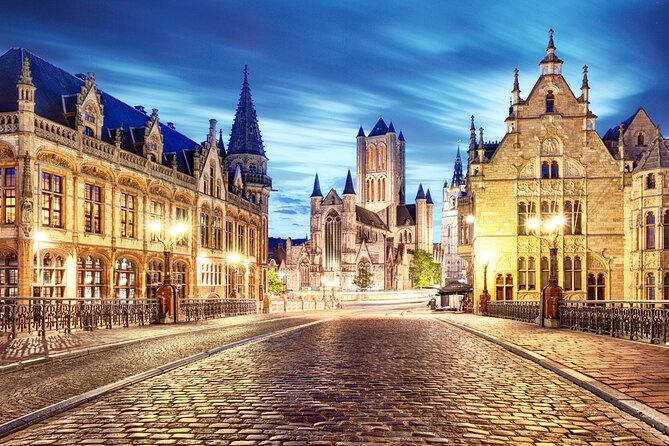
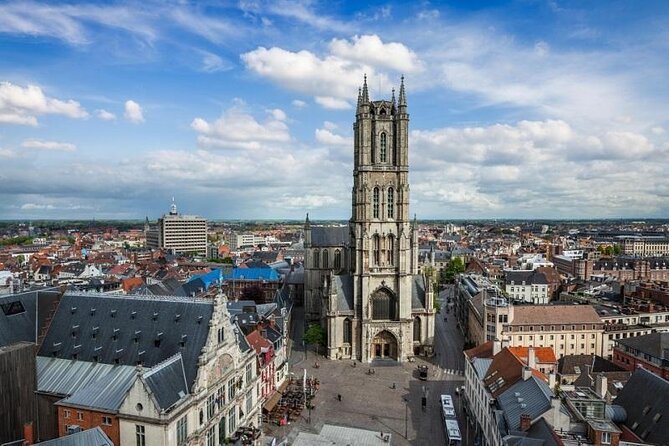
The meeting point is Hostel Uppelink at Sint-Michielsplein 21. The walk begins at St Michael’s Bridge, one of the finest viewpoints in Ghent. From here, your guide introduces the city as a major medieval trading center and points out the famous three towers that shape the skyline.
This is an excellent opening because it gives you a visual map of central Ghent. You can see how the church towers and civic buildings relate to one another, while the bridge provides a broad view of the old city. At night, the scene is particularly photogenic, and several people specifically value the chance to take nighttime pictures during the walk.
The history of trade also sets up the rest of the evening. Ghent was not just a pretty medieval town. It was a powerful economic center, and money, authority, and control explain many of the conflicts that follow.
The next story concerns the cathedral, known in this telling as the Devil’s Tower. The exact tale is presented as a gruesome one, so this stop shifts the mood from grand city views to darker local tradition. It is a good reminder that Ghent’s landmarks often carry layers of myth and unpleasant history beneath their elegant façades.
Graslei and Korenlei, where money shaped the city
At Graslei and Korenlei, the group reaches the old medieval harbor. This is one of Ghent’s most attractive waterfront areas, but the guide focuses on its commercial role rather than only its architecture.
You hear about the profitable trading activity that helped make Ghent an economic powerhouse in Europe. The stop gives useful context for the city’s wealth. Grand buildings did not appear by accident, and the harbor was central to the movement of goods and money.
This part of the tour may feel less dark than the title suggests, but it adds needed balance. Ghent’s darker stories make more sense when you understand how much power and wealth were at stake. The old harbor is also an easy place to appreciate the guide’s style, since you can look at the surrounding buildings while listening rather than simply moving from one closed interior to another.
Appelbrugparkje and the story of a father and son
The walk continues to Appelbrugparkje, a bridge overlooking the large Butchers’ Hall. Here, the guide tells the legend of a father and son condemned to execution and the miraculous event that saved them.
This stop illustrates the tour’s mixture of fact, legend, and local memory. Not every story is presented as a verified event, and that is part of the appeal. The guide’s job is to show how Ghent’s identity was shaped not only by official history but also by dramatic tales repeated over generations.
If you prefer strict historical documentation, keep that distinction in mind. Some of the stories push toward folklore, and one account specifically noted that a few tales may stretch credibility. If you enjoy myths told with a wink, the uncertainty adds fun rather than taking away from the experience.
More evening tours in Belgium:
- Night Tour: The Dark Side of Bruges – by Legends
★ 4.8 · 18 reviews - Budapest: Buda Castle District Vampires and Myths Night Tour
★ 4.6 · 3,830 reviews - Haunted Evening Horse and Carriage Tour of Charleston
★ 4.5 · 3,678 reviews - Edinburgh: Evening Underground Ghost Tour
★ 4.4 · 3,092 reviews
The Castle of the Counts and medieval power
The Castle of the Counts is the most obvious setting for a dark-history walk. The fortress was built by Count Baldwin in the ninth century to protect local inhabitants from Viking raids, and the city began to develop around this stronghold.
The castle gives the guide a natural place to discuss defense, authority, and the harsh realities of medieval rule. You will hear how the fortification fits into Ghent’s early development, rather than seeing it as an isolated monument.
The tour does not include an admission visit inside the castle, so you are learning about it from outside. That keeps the walk moving and helps explain why the city grew around the fortress, but anyone wanting rooms, exhibits, or a detailed architectural visit will need a separate castle ticket.
The next stop recalls the Prince’s Court, once a huge palace. Little remains to make the former scale obvious, so your guide must rely on description and imagination. This is one of the more interpretive moments of the evening. You are asked to picture a vanished seat of power rather than study a complete monument.
Rabot Sluice and the last surviving defense tower
Rabot Sluice provides one of the tour’s more unusual stops. Here, you see the only remaining tower from the 14-kilometer defense wall that once surrounded Ghent in the Middle Ages.
This is exactly the sort of place that can be missed if you stick only to the best-known center. The surviving tower gives you a physical sense of how seriously the city treated defense. It also broadens the walk beyond the standard views of canals, churches, and ornate façades.
The stop is valuable because the remains are easier to understand with a guide. On your own, you might see an old tower beside the water and move on. With the story of the larger wall, the fragment becomes evidence of the size and ambition of medieval Ghent.
Keizer Karel and the scars of religious conflict
At Keizer Karel, the group reaches the Bridge of Imperial Delights. Four sculptures show legendary scenes from the life of Charles V, and the guide explains some of their meaning.
This stop connects public art with political history. Charles V is an important figure in the story of Ghent, and the sculptures offer a visual prompt for discussing imperial power and local identity. The guide does not simply point out statues. You get an explanation of the scenes and why they matter.
The following section deals with the Religious Wars and the impact of Calvinist rule on Ghent. This is one of the heavier historical subjects on the route. It shows how religious change affected the city’s leadership, public life, and built environment.
The tour’s strength here is its willingness to include complicated conflict in a short evening walk. The treatment is necessarily selective, but it gives you a framework for understanding why Ghent’s past includes so much political and religious tension. The subject also helps explain why the city’s history is not just a steady story of prosperity.
Patershol, the final stop in a medieval quarter
The walk ends in Patershol, a picturesque medieval neighborhood whose name means Monk’s Hole. This is a fitting final setting because the narrow old quarter feels more intimate than the wide waterfront views at the start.
Here, the subject shifts toward the social impact of the Industrial Revolution and the role it played in reviving Ghent’s economy. That ending prevents the tour from becoming a string of grim tales. You finish with a sense of how the city changed, declined, and found new economic life.
Patershol is also practical. The tour ends in the city center near many cozy bars and restaurants, so you can turn the walk into part of a full evening. You will not need to make your way back to the starting point after the final story.
The guides shape the experience
The strongest praise focuses on the guides’ delivery. Kenny is repeatedly described as funny, animated, personable, and good at involving the group. He combines jokes with detailed explanations and answers questions along the way. Isabel is described as enthusiastic and well informed, while Ben and Julian are also praised for making the history easy to follow.
That personal style is important here. The tour covers a lot in roughly 105 minutes, and the material includes legends, gruesome events, economic history, and religious conflict. A flat delivery would make the walk feel like a lecture. A spirited guide turns it into a moving story.
Because the exact guide may vary, you should expect some variation in emphasis. One guide might lean harder into murder and torture, while another may focus more on the city’s general past. The title promises the dark side, but the experience is still a broad history walk with a dark theme.
Timing, walking pace, and practical value
At the listed $3.62 per person, the value is excellent if the tour runs as scheduled. You receive nearly two hours of guiding, all fees and taxes are included, and the route covers major sights plus less familiar areas. Even if you already know central Ghent, the evening setting and local stories can give familiar streets a new mood.
You should wear comfortable shoes. The walk is not described as strenuous, and the pace is generally slow and mostly level, but it covers a wide part of the center. You will be standing and walking for close to two hours.
The activity is near public transportation, allows service animals, and most people can participate. It is offered in English only. Since it takes place outdoors and requires good weather, a cancellation may lead to a different date or a full refund.
Pay close attention to the confirmed meeting information. There are conflicting accounts about missed departures and confusion over the address, while the operator says the guide was waiting at the correct point. Arrive early, use the exact location in your confirmation, and do not assume the scheduled start time gives you extra margin.
The tour also requires a minimum number of participants. If that minimum is not met, the experience can be canceled and you will be offered another date, another experience, or a full refund. You can cancel for a full refund up to 24 hours before the start time, but late cancellations and changes are not accepted.
Who should book the Dark Side of Gent?
I would choose this walk if you want an entertaining introduction to Ghent that combines famous views with unusual stories. It suits first-time visitors who want help reading the city, families with older children who enjoy spooky history, and anyone looking for a low-cost evening activity.
It is especially useful on a first night because the route ends near restaurants and bars in Patershol. You can learn the city’s basic shape, note places you want to revisit, and continue straight into dinner.
I would skip it if you want a strictly academic account of Ghent, a private group, or a tour built around graphic horror at every stop. The storytelling includes myths and legends, and the balance between dark material and general city history may change with the guide.
For most people, though, the price, pace, scenic route, and strong guide performances make this a very easy tour to recommend. Book it with comfortable shoes, realistic expectations about the folklore, and enough interest in Ghent’s wider past to enjoy more than just the gruesome parts.
FAQ
How long does the Evening Tour of the Dark Side of Gent last?
The walk lasts approximately 1 hour and 45 minutes.
Where does the tour start?
The meeting point is Hostel Uppelink at Sint-Michielsplein 21, 9000 Gent, Belgium. The first sightseeing stop is St Michael’s Bridge.
Where does the tour end?
The tour ends in Patershol in central Ghent, near bars and restaurants.
What language is the tour offered in?
The tour is offered in English.
What is included in the price?
All fees and taxes are included.
How many people can join the tour?
The maximum group size is 35 people. The tour also requires a minimum number of participants to operate.
Can I cancel for a full refund?
Yes. You can cancel at least 24 hours before the start time for a full refund. Late cancellations and changes are not accepted. If poor weather or insufficient attendance cancels the tour, you will be offered another date or experience, or a full refund.
Just added around Belgium
- Private Tour: The Dark Side of Gent★ 5.0 · 73 reviews
- Private Tour: The Dark Side of Brussels★ 5.0 · 20 reviews
- Private Tour: The Dark Side of Bruges★ 5.0 · 70 reviews
- Private Tour: The Dark Side of Antwerp★ 5.0 · 84 reviews
- Private Tour: The Dark Side of Antwerp★ 4.5 · 7 reviews
- Night Tour: The Dark Side of Bruges – by Legends★ 4.8 · 18 reviews
- Haunted Bruges Walking Tour★ 5.0 · 3 reviews
- Ghent: The Dark Side of Ghent Private Walking Tour★ 4.9 · 19 reviews
Dark History & True Crime Tours, compared.
Adults-Only New Orleans Ghost, Crime, Voodoo, and Vampire Tour
Read our review →
The Deathly Dark Tour of York: Experience of the Year 2024
Read our review →
The Dark Side of Florence: Mysteries and Legends
Read our review →
Dark Secrets of the Old Town Ghost Walking Tour
Read our review →
New Orleans Adults-Only True Crime and Ghost Walking Tour
Read our review →
Genteel and Bard’s Savannah Dark History and Ghost Encounter Walking Tour
Read our review →
Buda Castle District Dark History, Legends and Vampire Night Tour
Read our review →Browse the lists this tour appears in