
REVIEW · DARK HISTORY & TRUE CRIME TOURS
Private Tour: The Dark Side of Gent
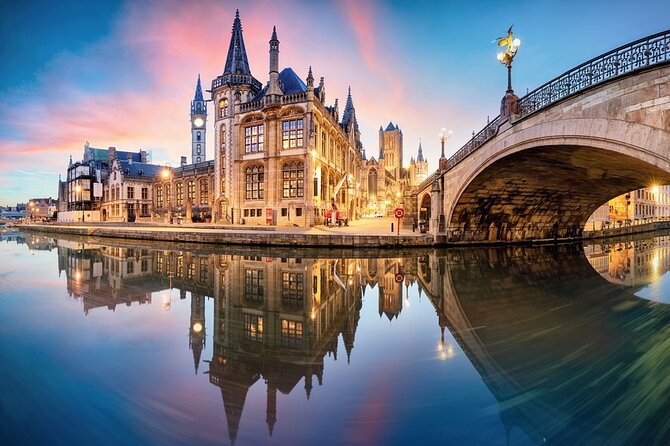
Ghent’s prettiest streets take on a different mood after sunset. This private walking tour uses the city’s medieval bridges, towers, churches, fortifications, and old lanes as the setting for stories about executions, religious conflict, imperial power, trade, and the legends that still cling to the stones. It is less a ghost walk than a history walk with a darker edge.
I like the private format, since your guide can pause for questions and adjust the conversation to your interests. I also like the finish in Patershol, a medieval quarter with bars and restaurants nearby, so the tour can lead naturally into dinner or a drink.
The main consideration is the title. This is not a nonstop horror tour. Some parts are grim, but other sections focus on trade, architecture, rulers, and the growth of Ghent. If you want theatrical scares at every stop, the experience may feel too mild. If you want a lively introduction to the city after the daytime crowds thin out, it is a much better match.
Key points to know before booking
- The tour covers ten central Ghent stops in about 1 hour and 45 minutes, from St Michael’s Bridge to Patershol.
- Private means only your group participates, which gives you more room to ask questions and set the pace.
- The dark stories vary in tone, from a father and son facing execution to religious conflict and the so-called Devil’s Tower.
- Several important sights are viewed from outside, including St Bavo’s Cathedral, Prinsenhof, and Augustijnenklooster.
- The English-speaking guides are the heart of the experience, with Kenny, Debra, Sébastien, Isabelle, Jerke, Hamraz, and others praised for warmth and storytelling.
- The ending is practical, with Patershol close to city-center restaurants and cozy bars.
Why Ghent works so well after dark
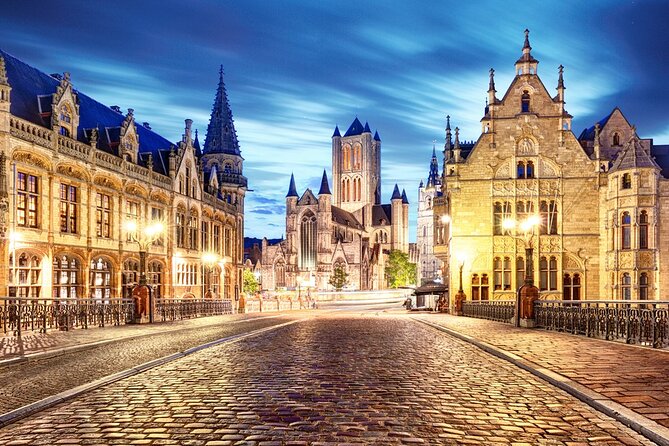
Ghent has an unusually strong evening setting. The medieval core is compact, and many of the key stops sit along old waterways, bridges, squares, and lanes. After dark, you have fewer daytime crowds to work around, and the city’s stories feel more connected to the buildings around you.
The tour’s title points toward the city’s less polished past. Ghent was wealthy and influential, but that prosperity came with hard trade, political struggles, punishment, religious violence, and rulers who did not always treat the people kindly. Your guide links those subjects to places you can actually see, rather than giving you a general lecture about Belgium.
That approach is useful on a first evening in town. You get a broad sense of how Ghent grew, who controlled it, and why its old center looks the way it does. One person described taking the tour early in a stay as a good way to get a first sense of the city, and I agree with that timing. You can use the rest of your visit to return to the places that catch your interest.
The mood also depends heavily on the guide. Kenny is often praised for being funny, engaging, and good with children. Debra is described as warm, enthusiastic, and especially strong on local history. Sébastien has drawn praise for an easygoing manner and a large store of information, while Isabelle was noted for clear English and strong knowledge of architecture. Those details matter because this tour is built around speaking and storytelling, not special effects.
More dark history tours in Belgium:
- Evening Tour: The Dark Side of Bruges
★ 5.0 · 956 reviews - Evening Tour of the Dark Side of Gent
★ 5.0 · 646 reviews - Evening Tour: The Dark Side of Brussels
★ 4.5 · 435 reviews
St Michael’s Bridge and the Three Towers
The walk begins at Hostel Uppelink on Sint-Michielsplein, beside St Michael’s Bridge. This is an excellent place to begin because it gives you an immediate view of Ghent’s famous Three Towers.
Your guide starts with the city’s role as a medieval trading hub. That opening gives the rest of the walk a useful frame. Ghent was not simply a pretty old town. Its position and commercial power shaped its buildings, politics, rivalries, and social structure.
The bridge also helps you see how much of the old center is packed into a small area. Rather than starting with a long explanation indoors, you begin outdoors with the city spread around you. The stop lasts about 15 minutes, the longest single introduction on the route.
Bring a moment of patience here. The Three Towers view is one of the tour’s visual highlights, but your guide’s explanation is just as important. You are learning how the skyline reflects different parts of Ghent’s civic and religious past.
St Bavo’s Cathedral and the Devil’s Tower story
The next stop is St Bavo’s Cathedral, seen from outside. Your guide explains why this beautiful church is also linked with the name Devil’s Tower, through a gruesome story from Ghent’s past.
The contrast is effective. The building looks dignified and grand, while the tale attached to it is far less comforting. That contrast captures the point of the tour: Ghent’s beauty does not erase the difficult events that took place here.
You do not enter the cathedral, and admission is not included. If you want to see the interior, plan a separate visit. The tour gives you context and the exterior setting, but it is not a substitute for an indoor cathedral visit.
Graslei and Korenlei, where trade made Ghent powerful
At Graslei and Korenlei, the focus turns to Ghent’s medieval harbour. These waterfront streets are among the city’s most attractive places, but your guide looks past the postcard view to explain the trading activity that helped make Ghent an economic force in Europe.
This is one of the tour’s most useful shifts in tone. The story is not only about crime and punishment. You also learn how money, goods, merchants, and river access shaped the city. The old facades make more sense once you understand the commercial life that supported them.
The stop lasts about 10 minutes. You will not get a full economic history of medieval Europe, but you will get enough background to read the waterfront as a working part of the city rather than only a scenic promenade.
More private ghost tours in Belgium:
- Private Tour: The Dark Side of Antwerp
★ 5.0 · 84 reviews - Private Tour: The Dark Side of Bruges
★ 5.0 · 70 reviews - Bruges: 1.5-Hour Dark Side of Bruges Private Tour
★ 4.3 · 59 reviews - Private Tour: The Dark Side of Brussels
★ 5.0 · 20 reviews
Appelbrugparkje and a grim execution legend
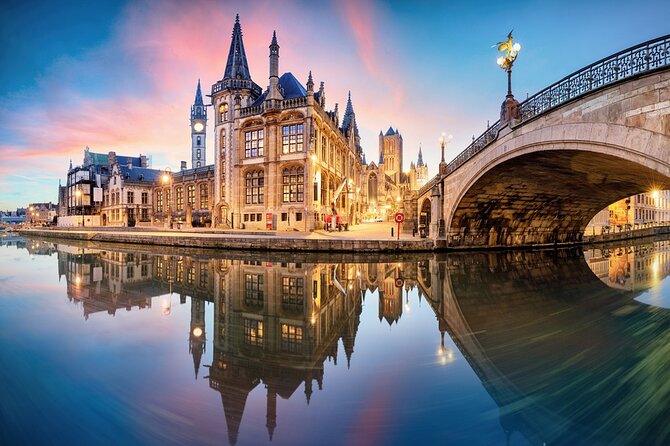
At Appelbrugparkje, the guide takes you to a bridge overlooking the large Butchers’ Hall. Here you hear the legend of a father and son sentenced to execution and the miraculous event said to have saved them.
This is one of the clearest examples of the tour’s darker side. It uses a specific place and a memorable story, rather than simply listing dates and rulers. The tale also gives you a chance to consider how legend and local identity can grow around public punishment.
You should expect this section to be told as a historical legend, not as a staged performance. The appeal depends on your guide’s delivery. Kenny, in particular, has been praised for making these stories fun without losing the historical setting.
Gravensteen, the fortress at the center of the city
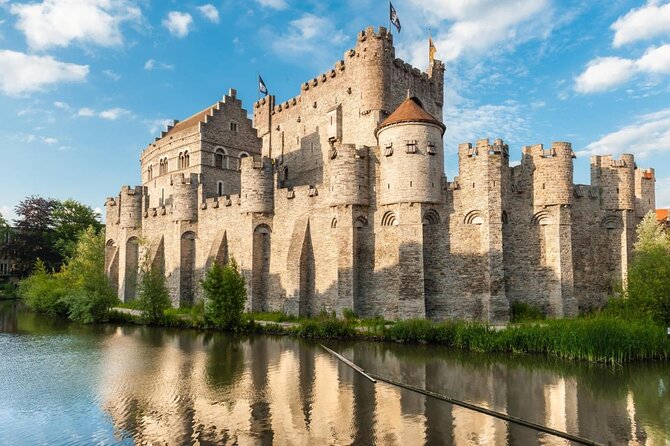
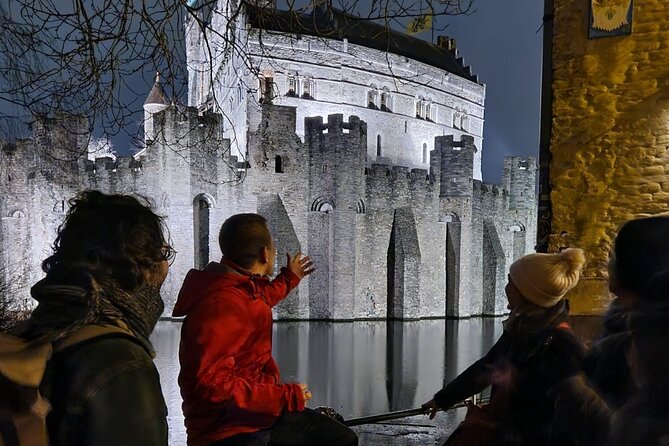
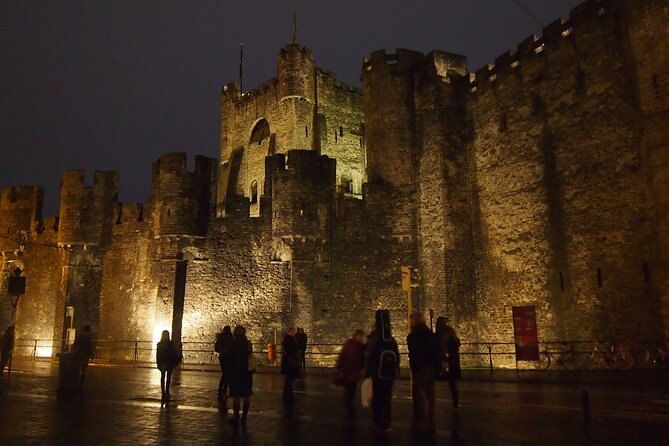
Gravensteen is one of Ghent’s strongest visual stops. The fortress was built by Count Baldwin in the ninth century to help protect residents from Viking raids, and the city began to develop around this defensive stronghold.
Even from outside, the castle gives the tour a solid sense of place. It is hard to discuss medieval power in abstract terms when a stone fortress is right in front of you. Your guide explains how the building fits into Ghent’s early growth and the city’s changing role.
Admission to Gravensteen is not part of this walking tour. That is worth noting if you want to visit the interior, since you will need to arrange that separately. The short stop is designed to give you the story and exterior view, not a castle tour.
Prinsenhof and the palace you have to imagine
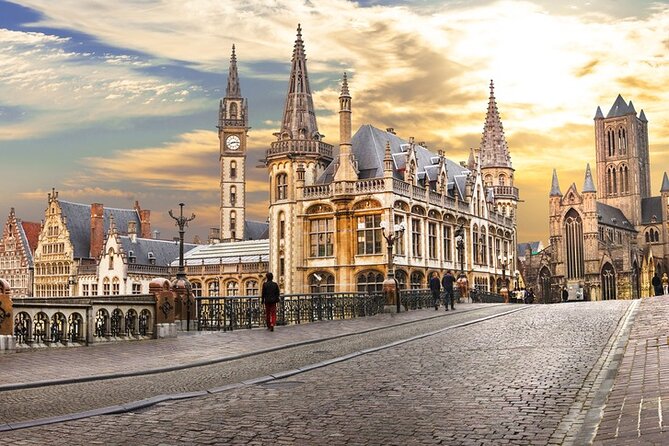
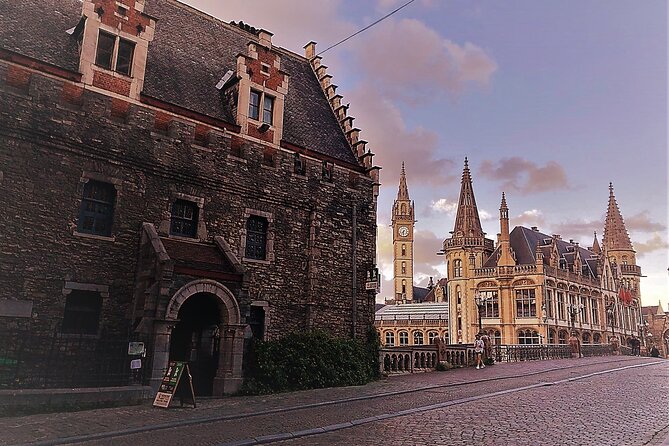
The route continues to Prinsenhof, once the site of a huge palace called the Prince’s Court. Much of the original complex is no longer visible in the way a preserved castle is, so this stop relies more on explanation and imagination.
That can be rewarding if you enjoy reconstructing a place from clues. It can also feel less dramatic than Gravensteen because the physical remains are not as complete. Your guide’s ability to make the vanished palace understandable matters here.
The tour does not enter the site. This is another outside stop, and admission is not included.
Rabot Sluice and Ghent’s lost defensive wall
At Rabot Sluice, you see the only remaining tower of the 14-kilometer defensive wall built around Ghent in the Middle Ages. The stop adds a broader view of the city’s defenses.
The important point is scale. Ghent was not protected by one castle alone. It had a much larger defensive system, and this remaining tower gives you a link to that vanished wall. The stop also moves the story beyond the most famous center sights.
The route includes the tower from outside, with no admission charge. If you care about medieval fortifications, this may be one of the more satisfying stops because it shows how much of the city’s protection has disappeared over time.
Keizer Karel and the Bridge of Imperial Delights
The stop named for Keizer Karel focuses on the Bridge of Imperial Delights. Four sculptures on the bridge show legendary scenes from the life of Charles V, and your guide explains some of them.
This section brings imperial politics into the walk. Charles V was born in Ghent, so his connection to the city is not a minor footnote. The sculptures offer a visual way to discuss how rulers are remembered and how public art turns political stories into local landmarks.
The stop is brief, about 10 minutes. That is enough for a few key scenes, but not a complete biography of Charles V. Think of it as a compact introduction that adds another layer to the city’s story.
Augustijnenklooster and the Religious Wars
At Augustijnenklooster, the subject becomes the Religious Wars and the effect of Calvinist rule on Ghent. This is one of the more serious parts of the tour, since religion here was tied to government, public order, and conflict.
The stop helps explain why Ghent’s history cannot be reduced to medieval trade and handsome buildings. Religious change had real effects on the city and its people. Your guide gives you a brief account of that troubled period while using the former monastery as the setting.
You do not enter the Augustijnenklooster, and admission is not included. The value is in the explanation and the connection between the building and the wider conflict.
Patershol, the right place to finish
The tour ends in Patershol, a picturesque medieval quarter whose name means Monk’s Hole. The final subject is the social effect of the Industrial Revolution and the part it played in reviving Ghent’s economy.
This ending gives the walk a useful final turn. You begin with medieval trade, move through power struggles and religious conflict, and finish with industrial change and economic recovery. Ghent’s story becomes one of decline, pressure, and adaptation rather than a frozen medieval picture.
Patershol is also a practical finish. You are close to many city-center bars and restaurants, so you can keep the evening going without arranging another transfer. Ask your guide for a food suggestion if that is part of the conversation, since some guides have offered useful local recommendations.
Private format, price, and overall value
The price is listed at $105.59 per person, with group discounts available. That is a significant cost for a walk lasting about 1 hour and 45 minutes, especially for one or two people. A private tour becomes easier to justify with a larger group, since the price buys your group exclusive time with the guide rather than a place in a large shared crowd.
The value comes from the format. You can ask about subjects that interest you, stop for clarification, and avoid a fixed group discussion dominated by strangers. Families may also appreciate the flexibility. Kenny has been praised for keeping children interested, which is useful since dark historical stories can lose younger listeners if the delivery is too formal.
The price is harder to defend if you want only a quick overview of Ghent’s main sights. You can see several of these places on your own, and the tour does not include entry to the cathedral, castle, palace site, or monastery. You are paying primarily for interpretation, organization, and private conversation.
One poor experience in the feedback described the walk as too flat and expensive for what it offered. That criticism is worth taking seriously. The tour depends on the guide’s energy and storytelling, and the title may set expectations for a darker, more dramatic experience than the actual route delivers.
Still, the overall rating is 4.9 from 73 reviews, with 99 percent recommending it. The strongest pattern is not a particular stop. It is the guide’s ability to make the walk personal, clear, and entertaining. That is the factor I would use most when deciding if the price works for you.
Who should book this evening walk
I would choose this tour if you want a first look at Ghent that mixes major sights with stories you might not find in a basic guidebook. It suits couples, families, and small groups who like asking questions and prefer a private guide to a scheduled group walk.
It is also a good fit for anyone who enjoys history but does not want a formal lecture. The tour covers trade, religion, rulers, defense, punishment, and industry in short sections, with the city itself providing the setting.
I would be more cautious if you want a pure ghost tour, a theatrical horror experience, or detailed interior visits. The route is dark in subject at times, but it is also a general city history walk. Some stops are scenic, some are architectural, and some depend almost entirely on storytelling.
Book it early in your stay if possible. That gives you a useful map of Ghent and lets you return to Gravensteen, St Bavo’s Cathedral, Graslei and Korenlei, or Patershol at your own pace. If your schedule allows only one short evening activity and you want a private introduction, this is a sensible choice.
Practical details for the walk
The meeting point is Hostel Uppelink at Sint-Michielsplein 21, near St Michael’s Bridge. The tour is offered in English and ends in Patershol in central Ghent.
Confirmation is provided at booking. The tour is near public transportation, service animals are allowed, and most people can participate. Since the experience lasts nearly two hours and visits ten outdoor stops, comfortable walking shoes and clothing suited to the evening are sensible choices, though the supplied details do not specify the walking distance or surface conditions.
Free cancellation is available up to 24 hours before the start time for a full refund. Changes or cancellations made less than 24 hours in advance are not accepted for a refund.
Should you book The Dark Side of Ghent?
Book it if you want a private, English-language introduction to Ghent with strong local storytelling and a slightly macabre angle. The best guides, including Kenny, Debra, Sébastien, Isabelle, Jerke, and Hamraz, have been praised for warmth, humor, clear explanations, and a real connection to the city.
Skip it if the $105.59 per-person price feels too high for an outdoor walk, or if you expect every stop to involve murder, ghosts, or frightening theatrics. The tour is at its best when you see it as Ghent’s wider story told through its darker chapters, not as a haunted-house performance.
FAQ
How long is The Dark Side of Ghent tour?
The tour lasts approximately 1 hour and 45 minutes.
Is this a private tour?
Yes. Only your group participates in the activity.
What language is the tour offered in?
The tour is offered in English.
Where does the tour begin?
It begins at Hostel Uppelink, Sint-Michielsplein 21, 9000 Gent, Belgium.
Where does the tour end?
It ends in the Patershol area of central Ghent, near bars and restaurants.
Is admission to St Bavo’s Cathedral included?
No. The cathedral is visited from the outside, and admission is not included.
Is admission to Gravensteen included?
No. The tour discusses Gravensteen from the outside, and admission is not included.
Is the tour suitable for most people?
Yes. Most people can participate, and service animals are allowed.
Are group discounts available?
Yes. Group discounts are listed as a feature of the experience.
Can I cancel for a full refund?
Yes. You can cancel at least 24 hours before the start time for a full refund. Cancellations made less than 24 hours before the start time are not refunded.
Just added around Belgium
- Private Tour: The Dark Side of Brussels★ 5.0 · 20 reviews
- Private Tour: The Dark Side of Bruges★ 5.0 · 70 reviews
- Private Tour: The Dark Side of Antwerp★ 5.0 · 84 reviews
- Private Tour: The Dark Side of Antwerp★ 4.5 · 7 reviews
- Night Tour: The Dark Side of Bruges – by Legends★ 4.8 · 18 reviews
- Haunted Bruges Walking Tour★ 5.0 · 3 reviews
- Ghent: The Dark Side of Ghent Private Walking Tour★ 4.9 · 19 reviews
- Brussels: 2-Hour Dark Side of Brussels Private Tour★ 4.8 · 16 reviews
Dark History & True Crime Tours, compared.
Adults-Only New Orleans Ghost, Crime, Voodoo, and Vampire Tour
Read our review →
The Deathly Dark Tour of York: Experience of the Year 2024
Read our review →
The Dark Side of Florence: Mysteries and Legends
Read our review →
Dark Secrets of the Old Town Ghost Walking Tour
Read our review →
New Orleans Adults-Only True Crime and Ghost Walking Tour
Read our review →
Genteel and Bard’s Savannah Dark History and Ghost Encounter Walking Tour
Read our review →
Buda Castle District Dark History, Legends and Vampire Night Tour
Read our review →Browse the lists this tour appears in