
REVIEW · GERMANY GHOST TOURS
Witch Trials in Bamberg
Bamberg’s witch-hunt story is darker and more surprising than the usual tale of old women accused of sorcery. On this 1.5-hour walk, you learn how suspicion reached men, women, wealthy citizens, and even Bamberg mayors, with the route ending at the former Malefiz-Haus site.
I like the way the tour ties grim events to the city’s streets and buildings, rather than treating the witch hunts as a detached history lesson. I also like the attention to everyday thinking in the period, something one German participant praised after finding the tour both informative and engaging despite cold weather.
The main drawback is language: the tour is offered in German only. The subject is also grim, so this is best for you if you want serious local history rather than a light ghost walk.
Key points to know before you book
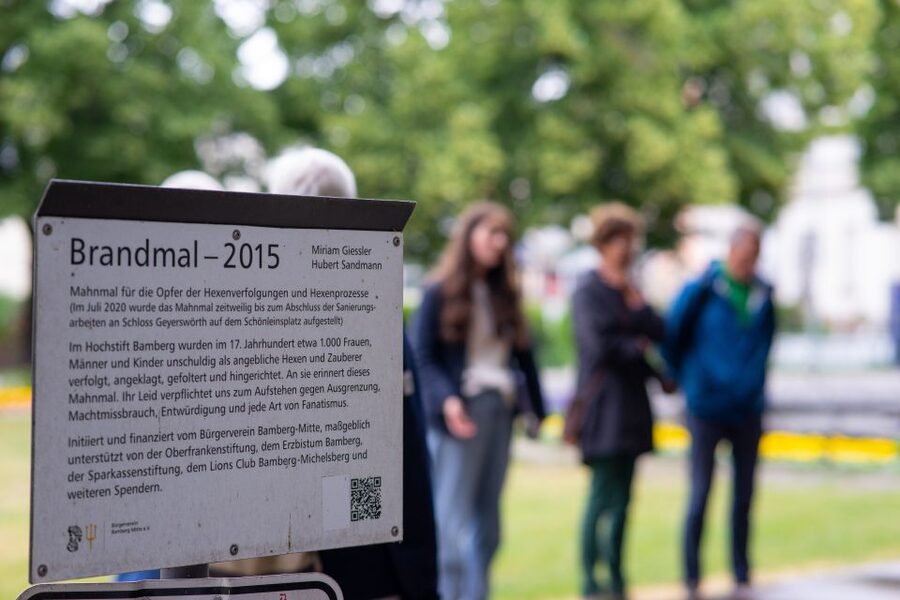
- The story reaches beyond old stereotypes: Accusations affected people from many social classes, including men and civic leaders.
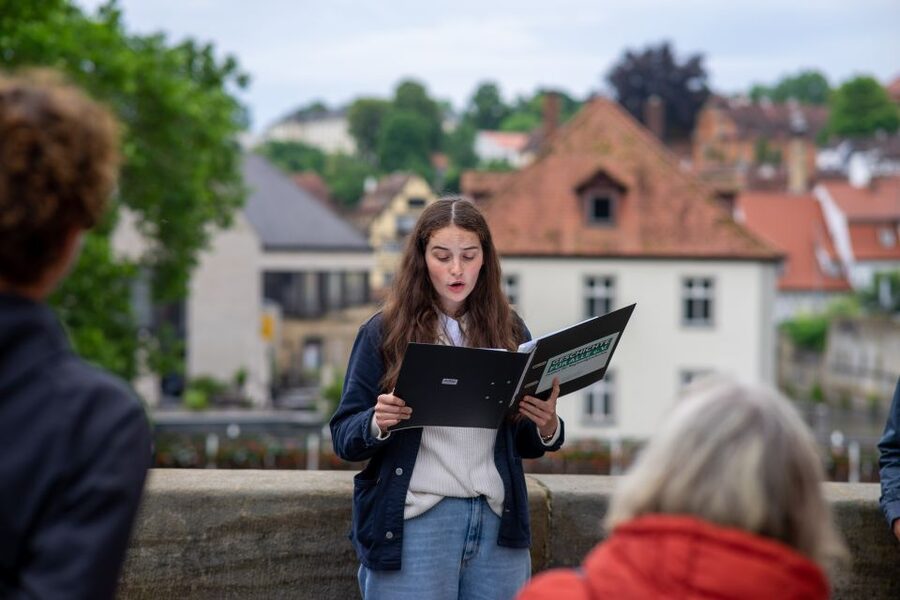
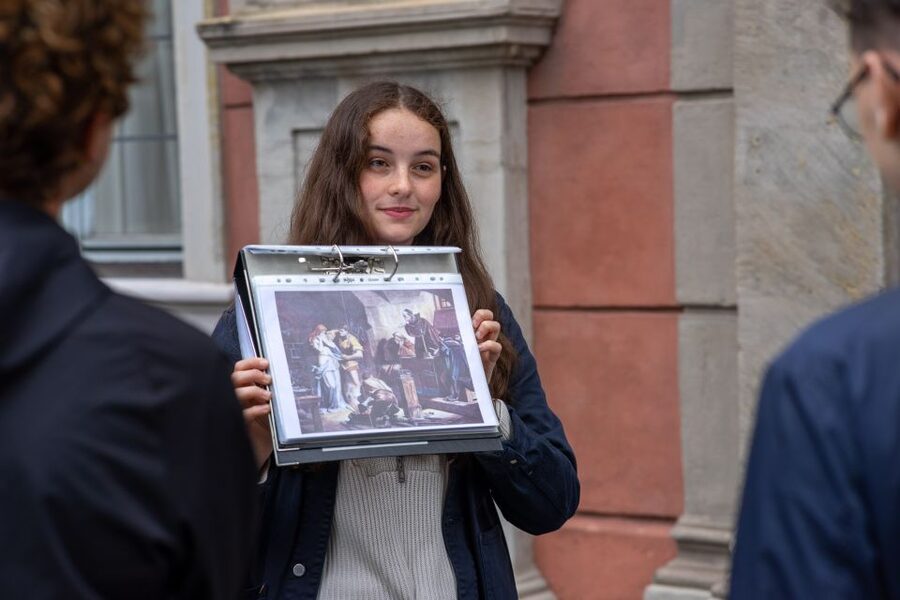
- The walk starts at Bamberg Cathedral Square: Meet in front of the Alte Hofhaltung entrance, where the guide carries a picture folder and wears a Geschichte Für Alle e.V. name tag.
- Historic stops anchor the story: The route includes the Old Court, Geyerswörth Palace, narrow old-town streets, and the former Malefiz-Haus site.
- The medieval prison is central to the subject: You learn about the Lochgefängnisse and the Trudenhaus, where accused people could face a grim fate.
- The tour lasts 90 minutes: The route uses several short walks of two to six minutes between guided stops.
- It costs $15 per person: That is a fair price for a focused, guide-led introduction to a difficult part of Bamberg’s past.
Why Bamberg’s witch trials make a powerful walking tour
The strongest part of this experience is its correction of a familiar myth. Witch hunts were not simply attacks on red-haired women or elderly mothers. In Bamberg, accusations could reach across social classes and include men as well as women.
That point matters because it changes the way you read the old town. The grand buildings and attractive lanes are not only pretty scenery. They were part of a working city with courts, prisons, officials, and systems of fear. As you walk, the guide places the trials within that urban setting.
The persecutions took place in the 17th century, when accusations of witchcraft could carry deadly consequences. Hundreds of people in Bamberg became victims of this persecution. The guide also explains how the hunt affected people in positions of power, including Bamberg mayors.
I like this approach because it gives you more than a list of dates and names. You get a clearer sense of how suspicion worked, how authorities responded, and why an accusation could be so hard to escape.
The tour also looks at the way Bamberg has dealt with this past up to the present day. That modern connection is useful. It keeps the subject from becoming a gruesome tale about a distant age and asks you to think about memory, responsibility, and how a city presents its own past.
More Witch Tours in Germany
- Munich: Witches and Executioners Guided Tour
★ 4.7 · 353 reviews - Oldenburg: “Executioners, witches & scoundrels” (crime thriller tour)
★ 4.6 · 50 reviews - Freiburg: Acting tour “Witches, Torture, Stake” with Historix-Tours
★ 4.7 · 42 reviews
Starting at Domplatz and the Alte Hofhaltung
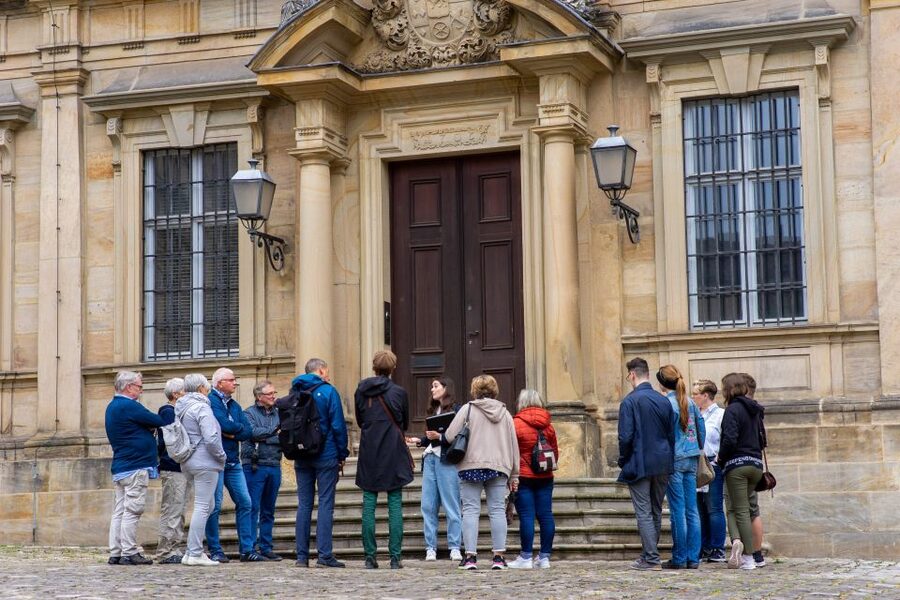
You meet on Bamberg’s cathedral square, Domplatz, in front of the entrance to the Alte Hofhaltung. This is a practical starting point because the square is easy to identify and places you immediately among some of Bamberg’s most important historic buildings.
Look for a guide with a picture folder and a name tag marked Geschichte Für Alle e.V. The provider is a local historical organization, and the guide is trained to lead the walk through Bamberg’s past.
The meeting point also sets the tone. You are not beginning in a modern meeting room or at a distant transport stop. You start in the historic center, surrounded by the architecture that gives the discussion a physical setting.
The tour is conducted in German. If you understand German well, you can follow a detailed explanation of the subject and ask questions. If you do not, the language point is a firm limitation, since no other language is listed.
The Old Court and the machinery of power

The first major stop is the Old Court, or Alte Hofhaltung. Here, the guide begins the historical explanation and connects Bamberg’s political and religious authority to the witch trials.
The Old Court is an especially useful place to begin because the story is not only about private superstition. It is also about institutions, officials, and the formal process that turned accusation into persecution.
You can expect the guide to explain the wider setting before the group moves deeper into the old town. That structure helps. Instead of hearing isolated stories, you get a framework for understanding how Bamberg operated in the 17th century.
This is also where the tour’s serious tone becomes clear. The subject concerns imprisonment, accusations, and the suffering of hundreds of people. Families with young children may want to consider that tone before booking, since this is history presented plainly rather than softened into entertainment.
After the Old Court, you walk for about five minutes to the next guided stop. The short distance keeps the pace comfortable and gives the guide room to use the streets as part of the explanation.
Geyerswörth Palace and Bamberg’s old lanes
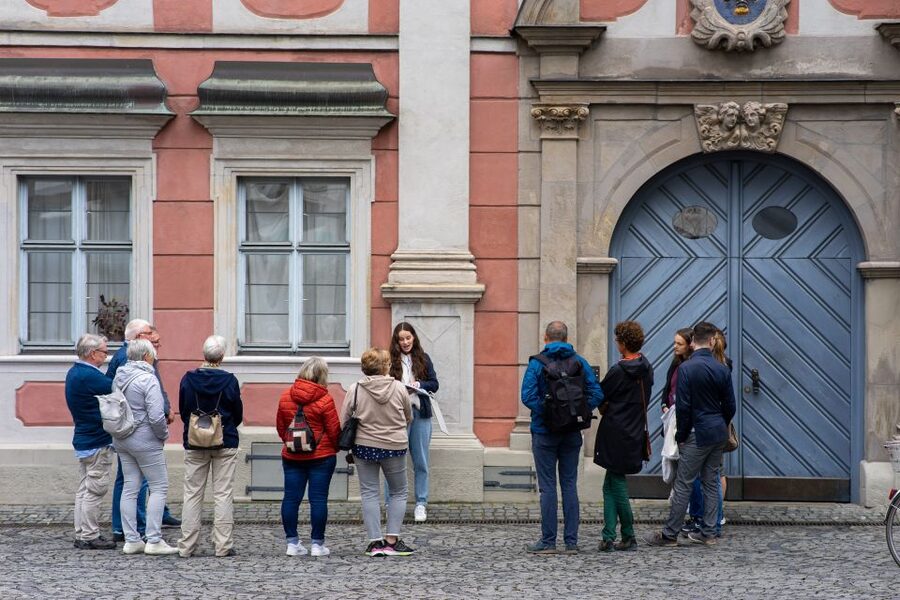
The route continues to Geyerswörth Palace, with another guided explanation along the way. The walk through the old town is important because Bamberg’s lanes are not just a backdrop between attractions.
The narrow streets help you picture the scale of the historic city. You move from one point to another on foot, with walks of about two, four, five, and six minutes appearing between later stops. This is a compact route, not a long city hike.
I like this format for Bamberg. A subject tied to local power and punishment makes more sense when you are physically moving through the old center. You get a sense of proximity between civic spaces, residences, courts, and places associated with confinement.
Geyerswörth Palace adds another architectural marker to the walk. The visit is not presented as a palace tour on its own. Instead, the palace forms part of a sequence of places that help explain the city’s social and political structure.
You should not expect every stop to be a large monument with an obvious sign about witch trials. Some parts of the route involve learning from the guide as you stand in the old streets. That can be a strength if you enjoy interpretation, but it may feel less satisfying if you want a series of preserved interiors or museum displays.
More witch trial tours in Germany:
- Cologne Haunted Quest: The Witch Self-Guided Tour
★ 3.0 · 38 reviews - Goslar: Witches – From delusion to myth
★ 4.7 · 16 reviews - Executioners, whores, witches with drama
★ 5.0 · 7 reviews - Witches, ghosts and executioners / Mystical North Hesse
★ 4.4 · 4 reviews
The Lochgefängnisse and the Trudenhaus
One of the most striking subjects is Bamberg’s medieval prison, known as the Lochgefängnisse. The tour also discusses the Trudenhaus, described as Bamberg’s witch prison.
The key lesson is blunt: anyone sent to the Trudenhaus was in serious danger. The prison was not a colorful setting for folklore. It was part of a system in which an accusation could lead to confinement and, for many, a devastating outcome.
The name Lochgefängnisse refers to prison spaces associated with the medieval period. Their inclusion gives the tour a useful physical dimension. You are not simply hearing that people were imprisoned. You are learning about the kinds of places used to hold them.
The prison material is likely to be one of the most memorable parts of the walk, but it is also among the grimmest. I would not choose this experience if you want a playful evening activity built around legends. Choose it if you want to understand how fear and authority operated in real places.
The guide also helps separate popular clichés from the historical record. The story is not limited to one type of accused person. Men and women from different levels of society could be caught in the hunt, including figures who might have seemed protected by status or office.
Following the clues toward the former Malefiz-Haus
The route ends at the site of the Malefiz-Haus from approximately 1627 to 1650. The final location gives the walk a clear destination and brings the earlier discussion of accusation, imprisonment, and punishment together.
Because the tour ends at a former site rather than a large attraction, you should expect the guide’s explanation to do much of the work. The value is in understanding what happened there and how the place fitted into Bamberg’s system of justice and persecution.
The sequence of short walks and guided stops also makes the ending feel earned. You begin near the Old Court, move through the historic center, learn about Geyerswörth Palace and the prison spaces, and finish at a location tied directly to the witch trials.
For me, this sort of ending is better than finishing at a gift shop or a general landmark. It leaves you with a specific place to remember, even if the site itself is not presented as a conventional attraction.
What the guide adds to the experience
The tour includes a trained guide from Geschichte Für Alle e.V. A live guide matters here because the subject needs context. A plaque can give you a date, but it cannot easily explain why accusations spread, how social standing failed to protect people, or how Bamberg has addressed the past.
The guide also uses a picture folder. That is useful when a location has changed or when the relevant evidence is not obvious from the street. You should look for the folder and the organization name tag at the meeting point.
The supplied feedback from recent German participants points to three qualities worth noting: clear explanation, detailed answers to questions, and an engaging presentation. One participant specifically praised the way the guide explained the thinking and daily life of the period. Another found the story excitingly told, while still describing it as informative.
That combination is important. A guide can make a dark subject gripping without turning it into cheap spectacle. The strongest version of this tour gives you facts, but also explains how people in that period understood danger, guilt, authority, and accusation.
There is no guide name provided, so you should not expect to request a particular person. The language is German, and the rating is 4.4 from 187 recorded ratings, which suggests a generally strong response without implying that every visitor will have the same experience.
Is $15 a fair price for 90 minutes?
At $15 per person, this is a reasonably priced history walk. You are paying for a trained guide, a focused subject, and a route through several historic locations rather than for admission to a major indoor attraction.
The value is strongest if you already plan to explore Bamberg’s old town. The tour adds meaning to places you may otherwise see only as attractive architecture. It can also give you useful background before visiting other historic sites in the city.
The price is less compelling if you need an English-language experience, want access to preserved prison rooms, or prefer a tour built around dramatic visual attractions. Those are not promised here.
The reserve-now-and-pay-later option gives you some flexibility, and free cancellation is available up to 24 hours before the start for a full refund. For groups of 10 or more, you need to contact the provider by email. Bookings made through GetYourGuide do not receive a separate invoice, since the booking confirmation serves as proof of payment.
Timing, pace, and access
The walk lasts about 90 minutes. The route includes several short stretches on foot, with the longest listed walk taking about six minutes. This makes the experience manageable for most people who are comfortable walking through an old town.
The activity is advertised as wheelchair accessible. Since the tour uses old alleys and historic outdoor areas, you may still want to confirm the exact route details with the provider if you have particular access needs.
Starting times vary, so check availability when choosing your date. Cold weather is worth considering. A German participant found the tour worthwhile even on a cold day, but the experience is largely outdoors, so suitable clothing matters.
The tour does not list food, drinks, hotel pickup, museum admission, or transport. The included service is the guided walk through Bamberg’s history.
Who should book the Bamberg witch-trials walk?
I would recommend this experience to you if you enjoy local history, social history, and guided walks that connect buildings with difficult events. It is especially useful for visitors who want to understand Bamberg beyond its attractive old-town views.
It suits history-minded adults, German-speaking visitors, and anyone interested in the way legal and religious ideas shaped ordinary lives. The discussion of men, women, civic leaders, and people from different social classes gives the subject more depth than a standard witch-story presentation.
You may want to skip it if you are looking for an English tour, a cheerful introduction to Bamberg, or a spooky performance with actors and theatrical effects. This is a serious historical walk.
Should you book it?
Book this tour if you can follow German and want a clear, place-based explanation of Bamberg’s 17th-century witch persecutions. The price is modest, the route is compact, and the guide-led format gives you context that you will not get from simply walking past the old buildings.
I especially like it for a first full day in Bamberg, when you are already exploring the cathedral square and old town. Just bring suitable clothing, prepare for a grim subject, and remember that the experience depends heavily on the guide’s spoken explanation.
FAQ
Where does the tour meet?
You meet on Bamberg’s cathedral square, Domplatz, in front of the entrance to the Alte Hofhaltung.
How do I identify the guide?
The guide carries a picture folder and wears a name tag showing Geschichte Für Alle e.V.
How long does the tour last?
The walking tour lasts 1.5 hours.
What language is the tour in?
The live guided tour is offered in German.
Is the tour wheelchair accessible?
Yes, the activity is listed as wheelchair accessible.
What does the tour include?
It includes a guided tour by a trained guide through the history of Bamberg.
Can I cancel the booking?
Yes. You can cancel up to 24 hours in advance for a full refund.
Just added around Germany
- Witches, ghosts and executioners / Mystical North Hesse★ 4.4 · 4 reviews
- Creepy city tour Experience the dark side of Görlitz★ 5.0 · 63 reviews
- Nuremberg Ghosts and Gallows Evening Walking Tour in English★ 5.0 · 56 reviews
- Executioners, whores, witches with drama★ 5.0 · 7 reviews
- The Original Haunted Walk of Munich in English★ 4.5 · 13 reviews
- Ghosts of Munich: The Haunted Apprentice Exploration Game★ 4.0 · 19 reviews
- Cologne Haunted Quest: The Witch Self-Guided Tour★ 3.0 · 38 reviews
- Gruseltour Berlin Haunted Ghost Walk 90-minute at Berlin Mitte city center★ 5.0 · 75 reviews
Germany Ghost Tours, compared.
Munich Ghosts and Spirits Evening Walking Tour
Read our review →
Görlitz: Ghosts and Spooky Historical Night Walking Tour
Read our review →Browse the lists this tour appears in