
REVIEW · ROME GHOST TOURS
Rome After Dark Mysteries Myths and Haunted History
Rome after dark is a different city. The grand ruins fade into shadow, narrow lanes feel more secretive, and familiar squares take on a darker edge. This short walking tour uses that setting well, linking executions, ghost stories, papal escape routes, and old Roman legends from Castel Sant’Angelo to Campo de’ Fiori.
I like two things right away. First, the route is compact, so you can fit it into an evening without giving up hours of sightseeing. Second, it takes you to small passages and quiet corners that are easy to miss when you stick to Rome’s main sights. The main drawback is that the group can reach up to 100 people, so the experience may feel less personal if it fills to capacity.
Key points to know before you book
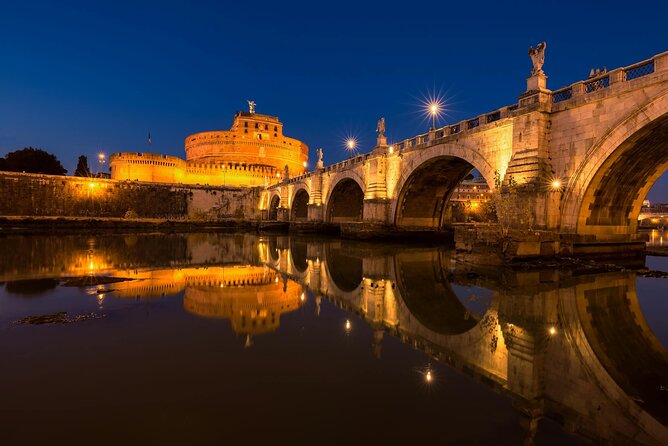
- Castel Sant’Angelo sets the mood: Hear about prison cells, executions, the Passetto escape route, and Saint Michael’s appearance above the fortress.
- The route covers central Rome on foot: You move through Via Giulia, Piazza Farnese, Passetto del Biscione, and Campo de’ Fiori.
- The stories mix fact with folklore: Expect historical events, local legends, supernatural tales, and Rome’s less polished past.
- The 9 pm start suits a full sightseeing day: The walk lasts about 1 hour and 20 minutes, making it an easy evening addition.
- The finish is useful: You end in Campo de’ Fiori, where bars and restaurants give you plenty of choices after the tour.
- The price offers striking value: At the listed $4.58 per person, this is an inexpensive way to add guided evening sightseeing to your Rome plans.
Why Rome feels different after sunset
Rome can be tiring. A day spent crossing between the Colosseum, the Vatican, and the historic center leaves little energy for another long tour. This experience works because it is short, local, and easy to place between dinner plans and a late drink.
The focus is not on the standard Roman greatest hits. You are not spending the evening inside a museum or waiting in line for an ancient monument. Instead, you walk through streets where the atmosphere does much of the work. Stone walls, church facades, old passageways, and dimly lit squares give the stories a natural setting.
The tone also appears to be more conversational than formal. Emily, Emilie, and Mike are the guides specifically associated with the experience, and the descriptions of their approach point to relaxed storytelling rather than a lecture packed with dates. That matters on a night walk. You want clear stories and a guide who can hold your attention, not a long list of names and rulers.
The tour is promoted around mysteries and haunted history, but you should not expect a staged scare show. The appeal is the mix of documented events, superstition, dark folklore, and the city’s physical setting. Some stories may feel eerie, while others are simply strange or grim.
More Ghost Story Tours in Italy
- Rome: Small Group Rome’s Dark Side – Ghosts & Legends Tour
★ 4.9 · 343 reviews - Ghosts, Legends & Mysteries of Rome Tip-Based Walking Tour
★ 4.7 · 284 reviews - Ghosts Legends and Mysteries of Rome Walking Tour
★ 5.0 · 149 reviews
Castel Sant’Angelo: fortress, prison, and papal escape route
The walk begins at Via del Banco di Santo Spirito, near Castel Sant’Angelo. This is a strong starting point because the castle carries several layers of Rome’s past in one place.
You hear about its role as a fortress and prison, including executions connected with the site. That changes how you see the building. During the day, Castel Sant’Angelo can look like a monumental tourist attraction beside the Tiber. At night, its history as a place of confinement and punishment becomes easier to imagine.
The guide also explains the Passetto di Borgo, the fortified corridor linking the castle with the Vatican. This passage gave popes a way to escape danger, and its purpose adds a practical edge to the story. Medieval and Renaissance Rome was not only a city of churches and palaces. It was also a city where political threats could turn serious very quickly.
The Tiber receives attention here too. The river helped shape Rome’s growth and defense, and its presence gives the opening section a wider setting. You are not hearing isolated ghost tales. The stories are tied to the city’s geography, power, religion, and violence.
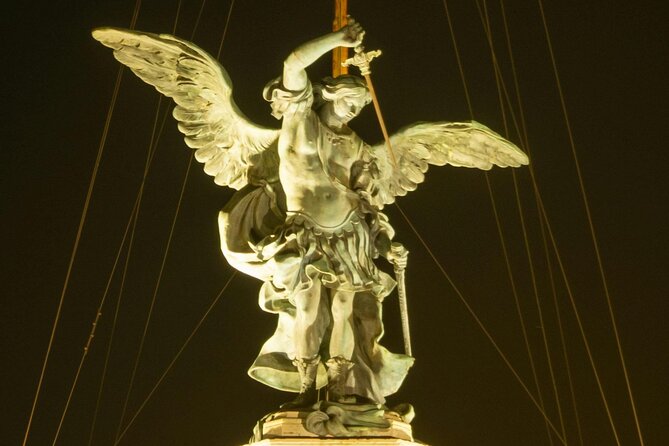
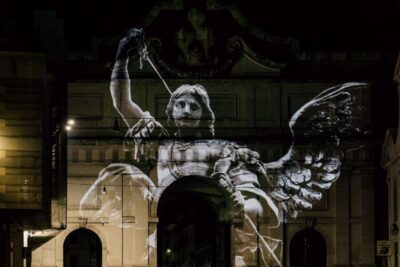
The most memorable legend concerns Saint Michael the Archangel. According to the story, an apparition appeared above the castle in 590 AD, signaling that a devastating plague had ended. The event gave the fortress its name. It is the kind of story that shows how religious belief and public memory shaped Rome’s buildings.
The stop lasts about 12 minutes and does not include admission to the castle. That keeps the tour moving, but it also means you are seeing the exterior and hearing the story rather than touring the inside. If Castel Sant’Angelo is high on your list, plan a separate daytime visit.
Via Giulia and the planned Renaissance city
From the castle, the route continues toward Via Giulia. This elegant street was designed by Pope Julius II in the early 16th century as a direct route through Rome.
The point here is not simply to admire a pretty street. Via Giulia shows how Rome was being reshaped during the Renaissance. Palaces, churches, and courtyards were arranged along a more deliberate urban route, replacing some of the disorder that had marked the older city.
The stop is brief, about five minutes, so do not expect a long architectural talk. Instead, use it as a change of pace. After the prison stories and plague legend at the castle, the street offers a quieter look at Rome’s grander ambitions.
I like this part because it connects the darker tales to ordinary city planning. A haunted walk can easily become a string of unrelated ghost stories. Here, the route keeps reminding you that Rome’s myths are tied to real streets and real political decisions.
Piazza Farnese and the drama of Renaissance power
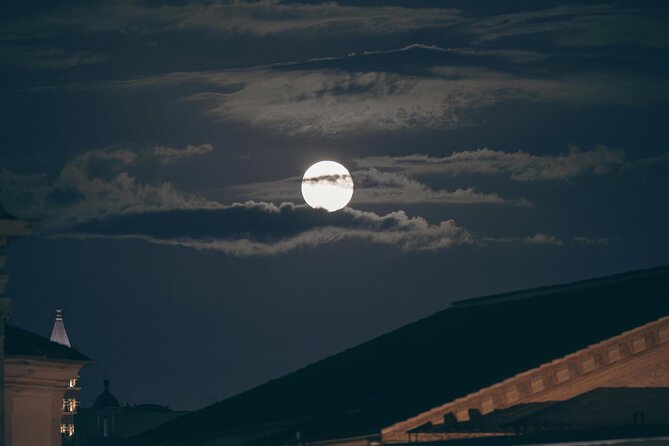
Piazza Farnese is another short but useful stop. The square is known for Palazzo Farnese, one of Rome’s great Renaissance palaces, linked with architects including Michelangelo.
The two large fountains are made from ancient Roman bathtubs. That detail captures Rome’s habit of reusing the past. Ancient objects were not always preserved in museums. They were pulled into new public spaces, given new functions, and made part of later power displays.
At night, Piazza Farnese can feel more formal than Campo de’ Fiori. Its broad layout and palace facade give the guide a chance to discuss the people who shaped Renaissance Rome. The darker side here is less about ghosts and more about power, status, and the long memory of the city.
The stop lasts around 10 minutes. It is a good reminder that the tour is not only for horror fans. You also get architecture, urban history, and small details that can sharpen your view of Rome the next day.
More Ghost Story Tours in Rome
- Rome: Capuchin Crypts & Ghostly Legends Small-Group Tour
★ 4.9 · 133 reviews - Rome’s Dark Side Ghosts and Legends Tour
★ 5.0 · 93 reviews - Crypts and Legends: Exploring the Dark Side of Rome
★ 4.5 · 69 reviews - Ghost & Legends in Night Rome Walking Tour
★ 5.0 · 36 reviews
Passetto del Biscione and Rome’s quieter corners
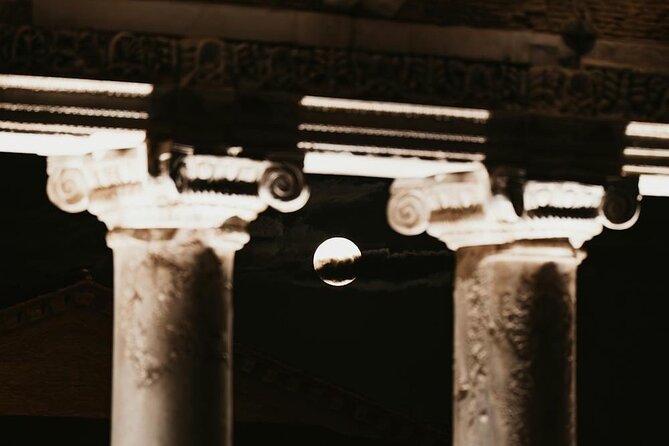
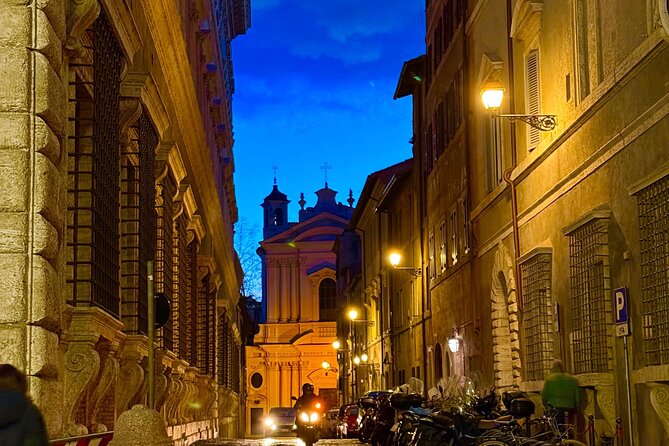
The route then turns toward Passetto del Biscione, a small square near Campo de’ Fiori. This is the sort of place many people miss when they move between Rome’s famous piazzas.
The square has an old-world feel, and the covered passage contains remnants of medieval frescoes. That combination gives the guide a natural setting for stories about age, mystery, and forgotten corners. You may find this section more atmospheric than dramatic. Its value comes from the setting and the sense that the main streets are only part of Rome.
The stop lasts about 12 minutes. Because the passage is a key part of the experience, listen closely as the guide points out the physical remains. In a city filled with famous churches and ruins, small fragments such as faded frescoes can be easy to overlook.
This is also where the tour’s compact scale works in your favor. You are not crossing the whole city to chase a story. The route links nearby sites, so the evening feels like one connected walk through central Rome.
Campo de’ Fiori and the city’s public punishments
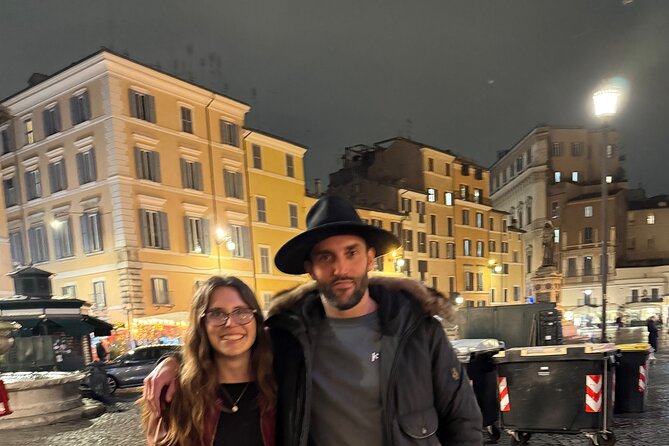
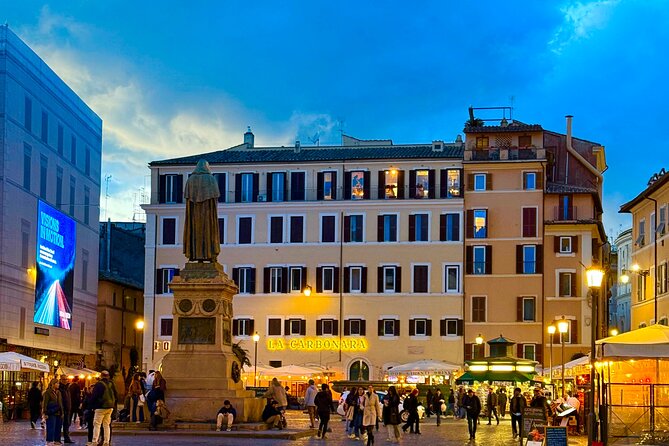
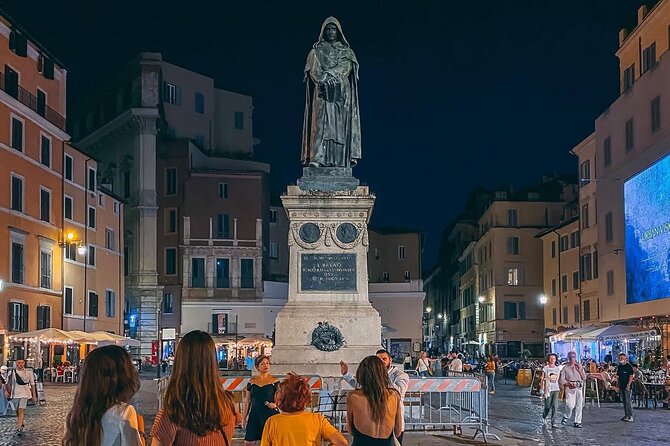
The longest stop is Campo de’ Fiori, with about 20 minutes devoted to the square. It is also the final stop and the place where the tour ends.
By day, Campo de’ Fiori is associated with its market, fresh produce, flowers, and local goods. At night, it changes into a social square filled with bars and restaurants. That contrast gives the guide a good way to explain how the same public space can carry very different meanings at different times.
At the center is the statue of Giordano Bruno, the philosopher who was executed here. His presence is a direct reminder of the square’s darker past. Public executions once took place in this busy part of Rome, and the current nightlife can make that history feel especially surprising.
I like ending here because you are not left in an isolated location. After the tour, you can stay in the piazza, find a drink, or continue exploring the evening on your own. Food and drinks are not included, so budget separately if you plan to stop at one of the bars.
Campo de’ Fiori can also be the noisiest part of the route. If you prefer quiet streets and eerie atmosphere, the earlier stops may appeal more. If you want an easy transition from a guided walk to Rome’s nightlife, the ending is practical.
What the storytelling style adds
A good night tour depends on delivery. The subjects can be strong, but a flat presentation makes even a plague legend feel like homework.
The guides connected with this experience include Emily, Emilie, and Mike. Their described style is casual, personable, and easy to follow. Mike’s relaxed approach, in particular, suits people who prefer a local telling stories rather than a formal history lesson. Emily and Emilie are also described in warm, attentive terms, with an emphasis on clear storytelling and lesser-known details.
You should expect the guide to move between historical facts and supernatural material. Some stories concern actual places and events, such as the castle’s executions or Campo de’ Fiori’s public punishments. Others draw on legends, religious stories, and old fears. The balance is part of the appeal.
The tour does not appear to take itself too seriously. That is a plus for an evening activity. You can enjoy the spooky mood without needing to believe every ghost story.
Duration, group size, and evening planning
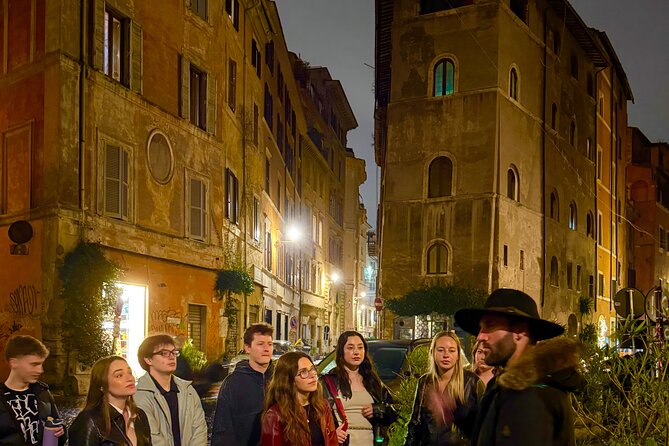
The advertised duration is about 1 hour and 20 minutes, beginning at 9 pm. Some descriptions refer to roughly 90 minutes, so allow a little flexibility rather than scheduling a meal immediately after the stated end time.
The start point is Via del Banco di Santo Spirito, 25, in central Rome. The finish is Piazza Campo de’ Fiori. Since the route is one way, you should think about where you want to eat before the tour and where you want to continue afterward.
The maximum group size is 100 people. That is a notable consideration. A group of that size can make it harder to hear in a busy square, and the walk may feel less intimate than a small group tour. On the other hand, the route uses open streets and public spaces, so a large group is less restrictive than it would be inside a small room.
The tour is conducted in English and uses a mobile ticket. Confirmation is provided at booking, and service animals are allowed. Most people can participate, but you should be comfortable walking between several nearby stops at night.
Is the $4.58 price good value?
At the listed price of $4.58 per person, the value is unusually strong. You get a local guide, a planned route through several historic areas, and more than an hour of evening sightseeing without paying admission fees at each stop.
The real value is not only the number of places covered. A guide gives meaning to details you might otherwise pass without noticing, such as the medieval fresco remnants at Passetto del Biscione, the ancient bathtubs reused as fountains in Piazza Farnese, or the story behind Saint Michael above Castel Sant’Angelo.
Still, price alone should not set your expectations too high. The tour is a walking introduction, not a full visit to the castle or a private history seminar. You are paying for guided storytelling in public spaces, with no food, drinks, or attraction admission included.
Free cancellation is available if you cancel at least 24 hours before the 9 pm start time. Inside that window, the payment is not refunded, and changes are not accepted. That policy is simple, but it is worth remembering if your Rome plans are still shifting.
Who should book this Rome night walk?
I would choose this tour if you want to see a less familiar side of central Rome without committing to a long evening. It suits first-time visitors who have already spent the day on major sights and want something different after dinner.
It is also a good match for people who like history with a darker edge. You will hear about prisons, executions, plague, religious visions, public punishment, and local legends. The material is atmospheric, but it is still tied to real streets and buildings.
Families and mixed-age groups may find the short format useful, though the subject matter includes executions and other grim events. People who want a quiet, private experience should note the possible group size of 100.
You may want to skip it if you prefer indoor attractions, detailed art history, or a tour built around entering monuments. The main strength is the walk itself and the guide’s storytelling, not access behind closed doors.
Should you book Rome After Dark Mysteries, Myths and Haunted History?
Book it if you want a short, low-cost evening walk that adds stories to streets you might otherwise pass without a second thought. The route covers several central locations, begins near Castel Sant’Angelo, and ends in a square full of places to continue your night.
I especially like the mix of real history and folklore. The castle’s prison past, the papal escape corridor, Giordano Bruno’s execution, and the old passage at Passetto del Biscione give the tour substance beyond simple ghost stories.
Skip it if you need a small group, a guaranteed quiet atmosphere, or entry into Rome’s monuments. For everyone else, the modest price and compact route make this an easy addition to a Rome itinerary, especially after a long day of sightseeing.
FAQ
Where does the tour begin?
The tour begins at Via del Banco di Santo Spirito, 25, 00186 Roma RM, Italy.
Where does the tour end?
The tour ends at Piazza Campo de’ Fiori, where you can find bars and continue exploring Rome at night.
What time does the tour start?
The start time is 9:00 pm.
How long does the tour last?
The tour lasts approximately 1 hour and 20 minutes. Some details describe the experience as taking around 90 minutes, so allow a little extra time.
Is the tour offered in English?
Yes. The tour is offered in English.
Are food and drinks included?
No. Food or drinks purchased at bars during or after the tour are not included.
What is the cancellation policy?
You can cancel for a full refund up to 24 hours before the experience start time. Cancellations or changes made less than 24 hours before the start are not accepted and are not refunded.
More Heritage Tours in Rome
- Rome: Guided Bar Crawl with Drinks & Dark History
★ 4.9 · 444 reviews - Rome Secrets: Dark History & Tasty Bites Tour
★ 5.0 · 37 reviews - Rome: Colosseum and Ancient Dark History Walking Tour
★ 5.0 · 10 reviews - Rome Secrets with Dark History and Tasty Bites Tour Experience
★ 4.5 · 3 reviews
Just added around Rome
- Ghost & Legends in Night Rome Walking Tour★ 5.0 · 36 reviews
- Secrets of Rome – The dark side Small Group Walking Tour★ 5.0 · 20 reviews
- Rome: Private Night Ghost Walking Tour★ 5.0 · 38 reviews
- Rome Secrets with Dark History and Tasty Bites Tour Experience★ 4.5 · 3 reviews
- Haunted Rome & True Crime: The Cenci Curse Game★ 4.5 · 27 reviews
- Experience Rome in this Mysterious Ghost Tour★ 3.5 · 3 reviews
- Haunted Rome: Eternal City Night Walking Tour★ 5.0 · 38 reviews
- Ghosts and Crimes of Rome Night Walk★ 5.0 · 61 reviews
Rome Ghost Tours, compared.
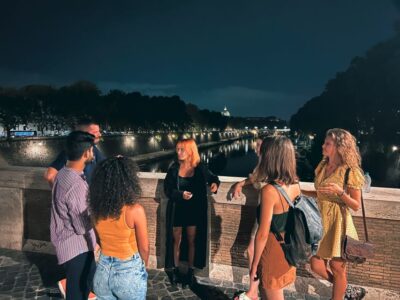
Paranormal Night Walking Tour & Secret Backstreets
Read our review →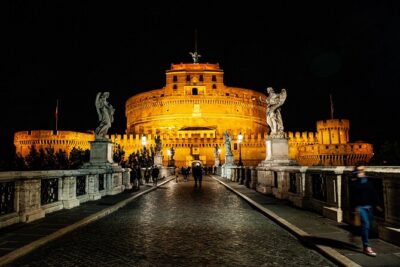

Small Group Rome’s Dark Side – Ghosts & Legends Tour
Read our review →
Ghosts, Legends & Mysteries of Rome Tip-Based Walking Tour
Read our review →
Ghosts Legends and Mysteries of Rome Walking Tour
Read our review →Browse the lists this tour appears in