
REVIEW · ROME GHOST TOURS
COMBO: Rome’s Capuchin Crypts Tour & Rome’s Dark Side Ghost Tour
Rome keeps its darkest stories close to its grandest sights. In this four-hour evening experience, you begin among the 3,500 skeletons of the Capuchin Crypts, then walk through central Rome as fountains, churches, bridges, and piazzas take on a more troubling meaning.
I like the sharp contrast between the crypts and the street tour, and I like the small group, capped at 15 people. Guides such as Ben, Ivana, and Alethea have been praised for turning difficult material into clear, entertaining stories, including tales that can hold the attention of teenagers and repeat visitors to Rome.
The main drawback is the pace. You cover many stops on foot, with some of them lasting only 5 or 10 minutes. If you want long visits inside monuments or a gentle stroll with plenty of time for photographs, this is not that kind of tour.
What makes this Rome tour worth your evening
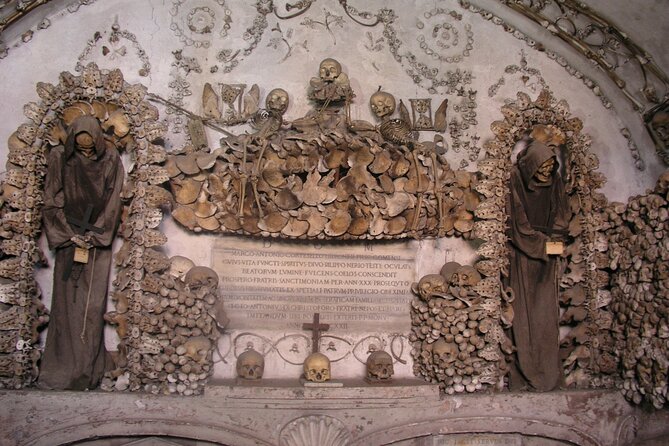
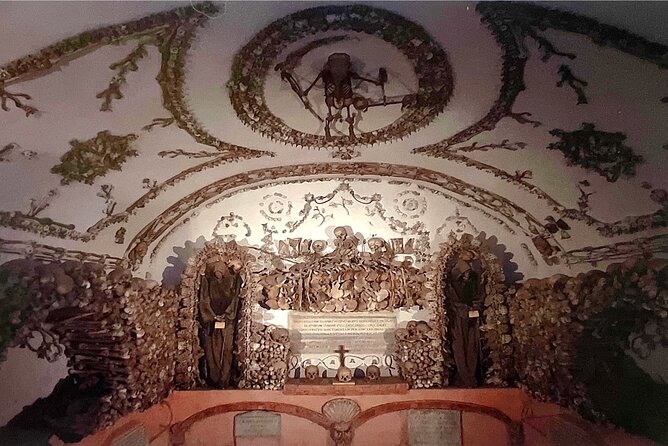
- The Capuchin Crypts begin the experience with 3,500 human skeletons, arranged in unusually macabre decoration.
- Rome’s famous sights get a darker reading, from the Trevi Fountain and Pantheon to Piazza Navona and Castel Sant’Angelo.
- The route links major landmarks with lesser-known streets, including Via dei Banchi Vecchi and Vicolo delle Grotte.
- The stories range from ancient legends to Second World War tragedy, giving the tour a wide historical span.
- A maximum of 15 people keeps the group fairly intimate, useful when you need to hear a guide outdoors.
- The $66.01 price includes the crypt admission, while the rest of the route uses public streets and squares.
Start with bones beneath Via Veneto
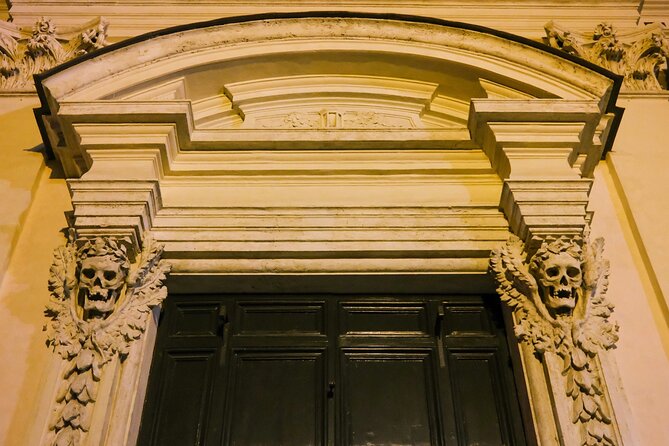
The tour begins at 5 p.m. on Via Vittorio Veneto, at number 19. Your first stop is the Museum and Crypt of Capuchin Friars, where you spend about 40 minutes learning how the crypt became decorated with the remains of Capuchin friars.
This is not simply a room full of bones. The arrangement is the point. Skulls and bones form an unsettling decoration, and the guide explains the story behind the place rather than leaving you to stare in silence. The result is eerie, but also strangely thoughtful. The crypt asks you to consider mortality, religious life, and the way Rome has always placed death close to daily life.
I would give this first section your full attention. It is the only stop with an included admission ticket, and it provides the visual anchor for everything that follows. After seeing actual remains arranged as decoration, stories of executions and hauntings feel less like cheap ghost-show material and more like part of Rome’s long relationship with death.
The crypt is also the clearest reason to choose this combination instead of booking only a standard evening walk. You get a distinct site visit first, then an outdoor route built around stories. The two halves have different moods, which helps keep four hours from feeling repetitive.
More Dark History Tours in Italy
- Rome: Guided Bar Crawl with Drinks & Dark History
★ 4.9 · 444 reviews - Rome: Small Group Rome’s Dark Side – Ghosts & Legends Tour
★ 4.9 · 343 reviews - Rome’s Dark Side Ghosts and Legends Tour
★ 5.0 · 93 reviews
Via Rasella brings the past into the modern era
The route moves into Rome’s center and stops at Via Rasella for about five minutes. Here, the subject is a tragic event from the Second World War.
This short stop matters because it prevents the tour from treating darkness as nothing more than medieval murder and ghost lore. Rome’s troubling past is not locked in the distant centuries. The guide connects the city’s streets with a modern wartime event, giving the route a more serious edge.
You will not spend long here, so listen closely. The stop is designed for a concise explanation rather than a full museum-style presentation. That pattern continues through much of the walk: the guide offers a story, you take in the setting, and the group moves on.
The Trevi Fountain after sunset
At the Trevi Fountain, the familiar scene gets a new angle. You hear a darker tale involving longing and murder, along with the possibility that the place remains haunted.
The fountain is usually one of Rome’s most cheerful stops. Its water, lights, and crowds invite photographs and coin-tossing rituals. This tour asks you to look beyond the postcard image and imagine the human drama attached to the setting. I like that use of a famous landmark. You do not need another explanation of what the fountain looks like. You need a reason to see it differently.
The stop lasts around 10 minutes. That is enough for the story, but not enough for an extended visit. If the fountain is high on your sightseeing list, you may want to return separately when you can take your time.
The Pantheon and a gruesome neighbor
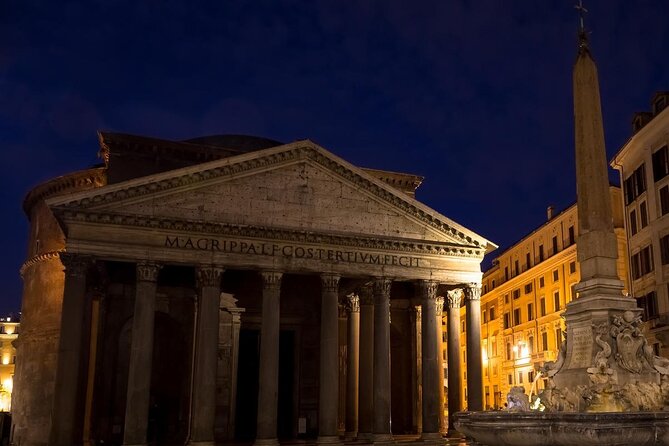
At Piazza della Rotonda, the Pantheon provides the grand backdrop. The focus, however, shifts to a building directly opposite, one with a gruesome past that is said to have inspired similar legends elsewhere.
This is a good example of the tour’s method. Rome’s most famous monument is not ignored, but it is not the entire subject either. You look across the piazza and notice a less obvious part of the setting. The guide uses the contrast between the Pantheon’s celebrated architecture and the darker story nearby to show how much history can sit in plain view.
You spend roughly 10 minutes here. The stop works best if you enjoy connecting a landmark with the people and stories around it, rather than collecting only architectural facts.
More Dark History Tours in Rome
- Crypts and Legends: Exploring the Dark Side of Rome
★ 4.5 · 69 reviews - Rome Secrets: Dark History & Tasty Bites Tour
★ 5.0 · 37 reviews - Rome’s Dark Side: Ghosts, Scandals and Crypts – Small Group Tour
★ 5.0 · 28 reviews - Haunted Rome & True Crime: The Cenci Curse Game
★ 4.5 · 27 reviews
Piazza Navona’s haunted window and marble head
Piazza Navona gets about 20 minutes, making it one of the longer stops on the route. With roughly 2,000 years of history, the square has room for more than one unsettling story.
You hear two tales here, including one involving a haunted window. You also learn about the mysterious marble head that still watches over the square. These details turn Piazza Navona from a grand open space into a setting full of private grudges, odd relics, and local legend.
This is one of the stronger portions of the walk because the square is visually generous and easy to understand as a stage. You can look around while listening, then match the story to the buildings and statues around you. The stop is still not a guided monument visit, so you should not expect entry into the surrounding buildings.
Giordano Bruno at Campo de’ Fiori
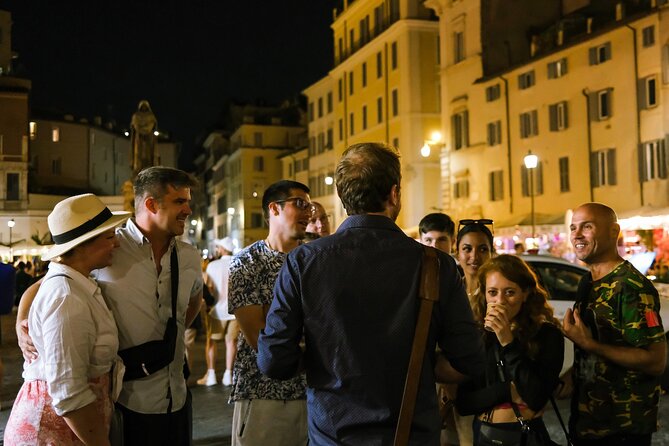
At Campo de’ Fiori, the focus turns to Giordano Bruno, whose scientific and philosophical ideas brought him into conflict with the Church. His statue now occupies the square, but the expression does not suggest a man pleased with his treatment.
The story gives the tour a useful change of pace. Not every dark tale is about a ghost. Some concern institutions, punishment, belief, and the price of challenging accepted ideas. The statue becomes more meaningful once you know why Bruno is remembered there.
You spend about 15 minutes in the square. This is a stop for ideas as much as atmosphere, and it will appeal to you if you prefer historical personalities to simple supernatural tales.
Narrow lanes and the magician of Vicolo delle Grotte
Vicolo delle Grotte brings the group into a narrower street and introduces a self-proclaimed magician said to haunt the area.
The setting helps here. A small lane naturally feels more intimate than a broad piazza, and the story can seem closer when the group is gathered in a confined street. Still, keep your expectations in check. The tour offers legends and storytelling, not a promise of paranormal proof.
The stop lasts about 10 minutes. The small-group format is particularly useful in places like this, where a large crowd could block the lane or make it difficult to hear.
From Ponte Sisto to the woman who ruled Rome
At Ponte Sisto, the story follows a woman who rose from poverty to rule Rome and is reputed to haunt the bridge. Her rise gives the guide room to discuss power, ambition, and reputation, not just fear.
This is one of the route’s more human stories. You are asked to consider the person behind the legend and decide for yourself if the haunting feels deserved, symbolic, or simply entertaining. The stop takes about 10 minutes.
From here, the tour continues to the Church of Santa Maria dell’Orazione e Morte. The church has unusual decoration, and the monks connected with it held an unusual role in public life. That stop also lasts about 10 minutes.
Together, these two locations show the range of the experience. One story concerns a powerful woman and a haunted bridge. The next uses a church and its unusual traditions to explore how Rome dealt with death in public and private life.
Prisons, poison, and Rome’s old executioner
The next stretch is the most concentrated run of grim stories. On Via di Monserrato, you hear about a notorious prison and the tortured souls said to remain in the street. The story is brief, about 10 minutes, but it adds another layer to the city’s older justice system.
Via dei Banchi Vecchi introduces one of history’s most prolific poisoners. The guide also explores why some people believe she was helping the women of Rome. This is a complicated tale, and it works best when you listen for the moral questions rather than expecting a simple villain.
Then comes Via del Banco di Santo Spirito, once home to Rome’s official executioner, who held the post for more than 60 years. The guide tells stories from his life and the work he performed. At around 10 minutes, this is another short, focused stop.
I appreciate this section because it moves away from the best-known sights. The streets themselves may not be the reason you came to Rome, but the stories explain how ordinary corners were tied to prisons, punishment, and survival. If you have already visited the Colosseum, Vatican, and major fountains, this kind of route can add a personal and unsettling layer to your understanding of the city.
The Cenci family at Castel Sant’Angelo
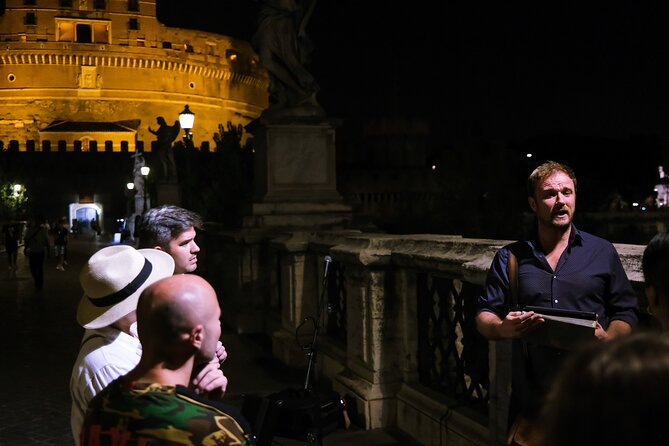
The walk ends at Castel Sant’Angelo, with the meeting point listed at Lungotevere Castello, 50. The final story concerns the Cenci family and the bridge, which was once connected with executions. A victim from one of Rome’s most tragic tales is said to haunt the area.
The guide leaves you to judge who was in the right. That is a useful ending because the story does not need to be reduced to a simple ghost anecdote. It brings together family conflict, punishment, public spectacle, and the question of justice.
The final stop is listed at about 10 minutes, and the tour ends at Castel Sant’Angelo rather than returning to the starting point. Plan your evening from there. The end point is useful if you want to continue sightseeing in that part of Rome, but you should not assume a return transfer is included.
Four hours of walking, stories, and quick stops
The advertised duration is about four hours, and the travel time includes walking between stops. This is an active experience, though the available information does not give a total walking distance.
Some stops are only five minutes. Others last 10, 15, or 20 minutes. That structure keeps the route moving, but it also means you need to stay with the group and pay attention. You are not getting long breaks at every landmark.
The tour is offered in English and uses a mobile ticket. It is near public transportation, and most people can take part. Snacks and drinks are not included, but a stop is made where you can buy them if you wish.
I would wear comfortable shoes and bring a light layer for the evening. Those are practical choices for any multi-hour walking tour, especially one that begins at 5 p.m. and ends outdoors at Castel Sant’Angelo.
Is $66.01 a fair price?
At $66.01 per person, the value depends on how much you want from a guided experience. The price includes admission to the Capuchin Crypts, plus about four hours of guiding through central Rome. You are paying for the crypt entry and for the work of linking 12 additional outdoor locations into one story-driven route.
I think the price is reasonable if you like guided storytelling and want something beyond standard sightseeing. The crypts alone would not fill the evening, and a self-guided walk would not necessarily give you the same sequence of legends, historical figures, and local details.
The value is weaker if you prefer to move slowly, enter several monuments, or spend long stretches taking photographs. Most of the outdoor locations are viewed from public streets and squares, and the short stop times favor storytelling over extended exploration.
Who should book this experience?
I would recommend it to you if you have already seen Rome’s famous sights and want to meet the city’s less polished characters. It is also a good fit for families with older children and teenagers, especially if conventional history tours lose their attention. Ivana has been especially effective at making the material engaging for younger participants.
You do not need to be a Rome expert. One particularly strong feature is that the stories can still add something after many previous visits or serious study of the city. The guide may connect a familiar fountain or piazza with details you have never encountered.
The tour also suits couples and friends looking for an atmospheric evening activity. Halloween adds an obvious seasonal mood, but the material does not depend on the calendar.
I would hesitate to book it for very young children, anyone uncomfortable with skeletons and murder stories, or anyone who does not enjoy walking between frequent stops. The tone is entertaining, but the subjects include executions, torture, poison, wartime tragedy, and death.
Small-group storytelling makes a difference
With a maximum of 15 people, this is not a private tour, but it is small enough for a guide to keep the group together and answer questions more easily. Outdoor storytelling can be hard to follow when a group is large, especially on a narrow street or in a busy piazza.
The guides have different personalities, but the strongest examples from this experience are Ben, Ivana, and Alethea. Ben is associated with a strong command of Rome’s darker stories, Ivana with an engaging approach that works for teenagers, and Alethea with quick, vivid storytelling that makes the hours pass fast.
The tone combines humor with serious material. That balance matters. Without humor, four hours of executions and ghosts could become heavy. Without historical detail, the tour could feel like a collection of spooky claims. The best moments appear to sit between those two poles.
Should you book the Capuchin Crypts and Dark Side tour?
Book it if you want Rome’s landmarks with the polished surface removed. The Capuchin Crypts provide the strongest visual experience, while the walking route gives you unusual stories about familiar places and streets you might otherwise pass without a thought.
Skip it if you want extended monument access, a slow sightseeing pace, or a tour built mainly around architecture. For everyone else, this is a well-priced way to spend an evening, with enough history to satisfy serious Rome fans and enough ghosts, bones, poison, and executions to keep the mood lively.
Free cancellation is available up to 24 hours before the 5 p.m. start time. Changes or cancellations made less than 24 hours ahead are not accepted for a refund.
FAQ
How long does the Capuchin Crypts and Dark Side tour last?
The combined experience lasts approximately four hours, including walking time between the stops.
What time does the tour start?
The tour starts at 5 p.m.
Where does the tour begin?
It begins at Via Vittorio Veneto, 19, 00187 Rome, Italy.
Where does the tour end?
The tour ends at Castel Sant’Angelo, Lungotevere Castello, 50, 00193 Rome, Italy.
Is admission to the Capuchin Crypts included?
Yes. The Capuchin Crypt entrance fee is included in the price.
Is the tour offered in English?
Yes. The experience is offered in English.
How large is the group?
The tour has a maximum of 15 participants.
Are food and drinks included?
No. Snacks and drinks are not included, but the tour makes a stop where you can buy them optionally.
Can I cancel for a full refund?
Yes. You can cancel at least 24 hours before the experience start time for a full refund. Cancellations or changes made less than 24 hours before the start are not accepted.
More Cemetery Tours in Rome
- Rome: Capuchin Crypts & Ghostly Legends Small-Group Tour
★ 4.9 · 133 reviews - Rome: Ghosts & Bone Crypts Tours: 2 Tours, 1 Discount Ticket
★ 4.9 · 37 reviews - Rome’s Dark Side: Ghosts, Scandals and Crypts – small group
★ 5.0 · 2 reviews - Edinburgh: Haunted Underground Vaults and Graveyard Tour
★ 4.6 · 6,607 reviews
Just added around Rome
- Ghost & Legends in Night Rome Walking Tour★ 5.0 · 36 reviews
- Secrets of Rome – The dark side Small Group Walking Tour★ 5.0 · 20 reviews
- Rome After Dark Mysteries Myths and Haunted History★ 5.0 · 14 reviews
- Rome: Private Night Ghost Walking Tour★ 5.0 · 38 reviews
- Rome Secrets with Dark History and Tasty Bites Tour Experience★ 4.5 · 3 reviews
- Haunted Rome & True Crime: The Cenci Curse Game★ 4.5 · 27 reviews
- Experience Rome in this Mysterious Ghost Tour★ 3.5 · 3 reviews
- Ghosts and Crimes of Rome Night Walk★ 5.0 · 61 reviews
Rome Ghost Tours, compared.
Paranormal Night Walking Tour & Secret Backstreets
Read our review →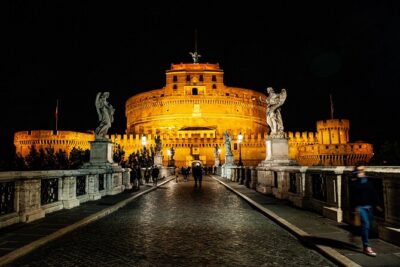

Small Group Rome’s Dark Side – Ghosts & Legends Tour
Read our review →
Ghosts, Legends & Mysteries of Rome Tip-Based Walking Tour
Read our review →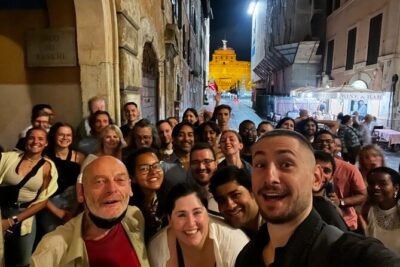
Ghosts Legends and Mysteries of Rome Walking Tour
Read our review →Browse the lists this tour appears in